GHK-Cu Canada
A Canadian research guide to GHK-Cu — the copper-binding tripeptide (glycyl-L-histidyl-L-lysine) studied for extracellular-matrix remodeling, antioxidant and anti-inflammatory signaling, gene modulation, and regenerative biology. What it is, how it works, and what quality standards matter for Canadian laboratories.
QUICK ANSWER: GHK-Cu Availability in Canada
- GHK-Cu is a naturally occurring copper-binding tripeptide complex — glycyl-L-histidyl-L-lysine bound to copper in its divalent (Cu²⁺) state — and one of the most widely studied copper peptides in laboratory research.
- In Canada, GHK-Cu is available through specialized domestic research peptide suppliers. It is not approved by Health Canada, the FDA, or any regulatory body for clinical, veterinary, or cosmetic use, and is sold strictly under a research-use-only framework Sourcing note: Canadian research suppliers.
- Research interest centers on three areas: extracellular-matrix (ECM) remodeling, antioxidant and anti-inflammatory signaling, and regenerative cellular behavior.
- Published gene-expression analyses report that GHK increases expression of roughly 59% of measured genes while suppressing the remaining 41% — a footprint far broader than a simple structural peptide Pickart et al., 2018.
- For Canadian labs, domestic suppliers offer delivery in 1–4 days with no customs handling, Canadian-dollar pricing, and reduced temperature-stability risk in transit.
GHK-Cu — Copper-Binding Research Peptide Glycyl-L-Histidyl-L-Lysine Tripeptide · Copper Transport & ECM Remodeling Research Third-Party Tested · Ships from Ontario · 2–4 Day Delivery.
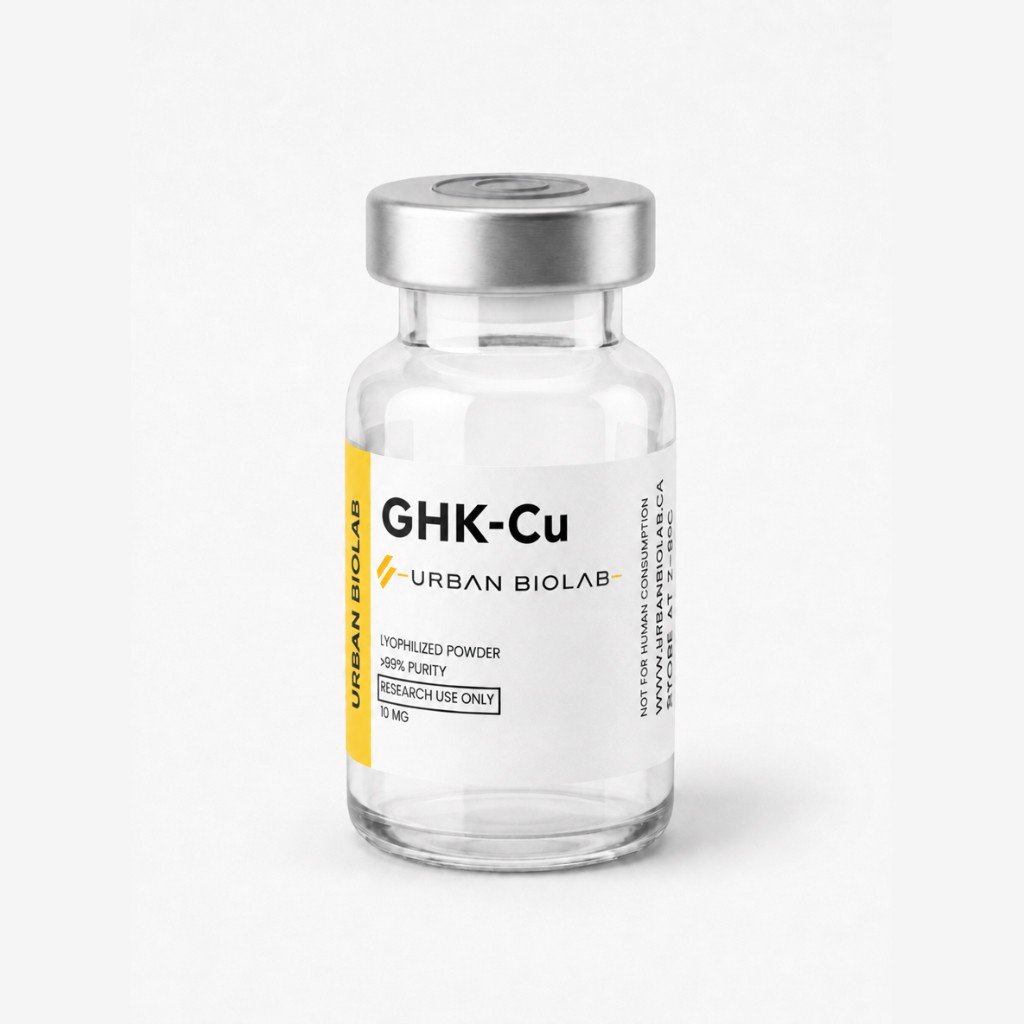
GHK-Cu 80MG
GHK-Cu 50mg is a copper-binding research peptide complex widely studied for its role in cellular signaling, tissue remodeling, and regenerative biology pathways. In laboratory research settings, GHK-Cu has attracted interest for investigations into wound-healing models, collagen synthesis pathways, and antioxidant activity, making it a valuable compound in skin, tissue, and cellular regeneration research.
Table of Contents
- Current Status of GHK-Cu in Canada
- What Is GHK-Cu and Why the Research Interest?
- Mechanisms of Action: The Three Research Pillars
- Gene Modulation and the Transcriptome-Level View
- GHK-Cu in Age-Related Research
- Understanding the Copper: Why Cu Matters
- Quality Verification and Purity Standards
- What Quality Documentation Should Look Like
- Storage and Handling for Stable Research Material
- Sourcing in Canada: Domestic vs. International
- GHK-Cu vs. AHK-Cu: How They Compare
- Regulatory Landscape and Research-Use Compliance
- Future Outlook for GHK-Cu Research
Frequently Asked Questions Glossary of Terms References
1. Current Status of GHK-Cu in Canada
GHK-Cu occupies a well-established position in Canadian laboratory research. It is not a pharmaceutical product, and no Health Canada approval exists for any therapeutic, cosmetic, or veterinary use — a point every reputable Canadian supplier states explicitly on its product pages Canadian supplier, research-use notice. Instead, GHK-Cu circulates in Canada as a research compound: legal to purchase and possess when sold for genuine laboratory and in-vitro research under appropriate oversight, with no therapeutic claims attached Peptide research framework overview.
Where it sits in the Canadian market:
| Category | Status in Canada |
|---|---|
| Pharmaceutical / approved therapeutic product | Not available — no Health Canada authorization |
| Cosmetic ingredient (topical formulations) | Marketed abroad; not reviewed or approved for this use by Health Canada |
| Research peptide (in-vitro / laboratory use) | Available through specialized Canadian suppliers |
| Clinical / human or animal use | Outside the framework — research-use-only applies |
Key Takeaway: GHK-Cu’s Canadian standing is unambiguous — it is a research material, supplied and used as one. Laboratories and individual researchers take full responsibility for their own research protocols and compliance.
2. What Is GHK-Cu and Why the Research Interest?
GHK-Cu is a small, naturally occurring tripeptide complex. The peptide portion — glycyl-L-histidyl-L-lysine (GHK) — binds copper ions with high affinity, and it is this copper-peptide interaction that gives the molecule its biological significance in research systems.
GHK was first identified in the early 1970s by Pickart and colleagues during studies of human plasma, a discovery that is frequently cited as the origin point of modern signal-peptide research Skibska & Perlikowska, 2021. In the half-century since, it has accumulated one of the deepest literature bases of any research peptide — spanning collagen biology, oxidative stress, gene expression, and regenerative signaling Pickart et al., 2015.
Why the sustained interest? GHK-Cu is not simply a peptide sequence — it is a copper-transporting signaling complex. In controlled systems, GHK acts as a carrier that delivers copper in a stable, non-toxic form to cells and copper-dependent enzymes, while simultaneously engaging multiple signaling pathways. That dual identity — metal-binding carrier plus signaling molecule — is what makes it relevant across so many research fields.
Did You Know: The “Cu” in GHK-Cu refers to copper in its divalent state (Cu²⁺). The copper-binding interaction is central to the complex’s stability and to nearly every mechanism researchers study.
3. Mechanisms of Action: The Three Research Pillars
In controlled laboratory settings, GHK-Cu is typically studied along three mechanistic lines: extracellular-matrix remodeling, antioxidant and anti-inflammatory signaling, and regenerative cellular behavior Pickart et al., 2015.
| Mechanism | What researchers study | Why it matters |
|---|---|---|
| Extracellular-matrix remodeling | Collagen synthesis, elastin-related pathways, glycosaminoglycan production, matrix metalloproteinase (MMP) regulation | Explains GHK-Cu’s central place in tissue-structure and remodeling research |
| Antioxidant and anti-inflammatory signaling | Reactive oxygen species (ROS) regulation, antioxidant enzyme activity, cytokine expression | Connects GHK-Cu to cell-protective and inflammation-related pathway studies |
| Cellular regeneration and migration | Fibroblast behavior, keratinocyte activity, stem-cell-related gene expression | Helps explain the peptide’s significance in repair-oriented laboratory work |
The collagen link is the oldest and best-documented strand: as early as 1988, Maquart and colleagues reported that glycyl-L-histidyl-L-lysine stimulates collagen synthesis in fibroblast cultures Maquart et al., FEBS Letters. More recent reviews extend the picture, examining GHK-Cu alongside other regenerative peptides in wound-healing and tissue-repair models Wojcieszuk et al., 2026.
4. Gene Modulation and the Transcriptome-Level View
The most striking feature of the GHK-Cu literature is the claim that this three-amino-acid peptide influences gene expression on a very wide scale. In the gene-expression studies analysed by Pickart and co-authors, GHK increased expression in roughly 59% of measured genes while suppressing it in 41% — including genes associated with tissue repair, inflammation, antioxidant defense, and cellular maintenance Pickart et al., 2018.
If these findings hold across systems, they give GHK-Cu a research footprint that few peptides of its size approach. Rather than acting through a single receptor or pathway, GHK appears to act as a broad modulator — resetting gene-expression patterns toward profiles associated with healthy regeneration and repair Pickart et al., 2018. This transcriptome-level view is why GHK-Cu is frequently discussed in the context of aging, cellular resilience, and regenerative biology.
Research Take: For Canadian researchers, the gene-modulation data is arguably the most compelling area of the GHK-Cu literature to watch — it is also the area most dependent on experimental conditions, so rigorous replication work remains an open field.
5. GHK-Cu in Age-Related Research
GHK is not an exogenous novelty — it is a component of human plasma, and its endogenous levels decline with age. That natural decline has been associated, in the research literature, with reduced regenerative capacity in aging biological systems, which is one reason GHK-Cu features so prominently in studies of oxidative stress and the degenerative conditions of aging Pickart et al., 2012.
The working hypothesis in the field is straightforward: if GHK is part of the body’s normal maintenance signaling, and if its levels fall with age, then restoring those levels in experimental systems may be a way to study — and potentially influence — age-related decline in repair capacity. This framing connects the peptide to three overlapping research agendas: aging, oxidative stress, and regenerative medicine Pickart & Margolina, 2018.
6. Understanding the Copper: Why Cu Matters
A common point of confusion is why GHK-Cu behaves differently from the copper-free GHK peptide used in some studies. The answer lies in coordination chemistry: GHK binds Cu²⁺ with very high affinity, forming a stable complex in which the peptide and the metal are effectively one research unit.
In research systems, this matters in two ways:
- Copper transport — GHK delivers copper in a stable, non-toxic form into cellular environments where copper-dependent enzymatic systems operate.
- Complex stability — the GHK-Cu complex is substantially more stable than free copper ions in solution, which affects how it behaves in cell culture and other in-vitro models.
Key Takeaway: When sourcing material for copper-signaling research, the peptide and its copper content are inseparable — purity claims should therefore cover the complex as supplied, not just the raw peptide sequence.
7. Quality Verification and Purity Standards
Because GHK-Cu sits outside pharmaceutical regulation in Canada, quality verification falls on the supplier and the researcher. The standards most cited across the Canadian research-supply market are consistent:
| Quality Criterion | Typical Research Standard | Why It Matters |
|---|---|---|
| HPLC purity | ≥ 98% for cell-culture and animal-model research; high-purity lines ≥ 99% | Cleaner pathway analysis and more reproducible results Purity guidance |
| Mass spectrometry | Confirmation of molecular identity (molecular weight match) | Verifies you received GHK-Cu, not a degraded or substituted product |
| Certificate of Analysis (COA) | Batch-specific, with testing date, method, and results | Traceability and documentation confidence |
| Presentation | Lyophilized (freeze-dried) powder | Stability during storage and shipping |
| Sequence verification | Confirmation of glycyl-L-histidyl-L-lysine identity | Guards against synthesis errors |
Market data on Canadian listings typically shows research-grade GHK-Cu testing at 97–99% purity by HPLC, with anything below roughly 95%, or a COA missing identity confirmation, widely considered a red flag by the researcher community LabDoc GHK-Cu vendor notes.
8. What Quality Documentation Should Look Like
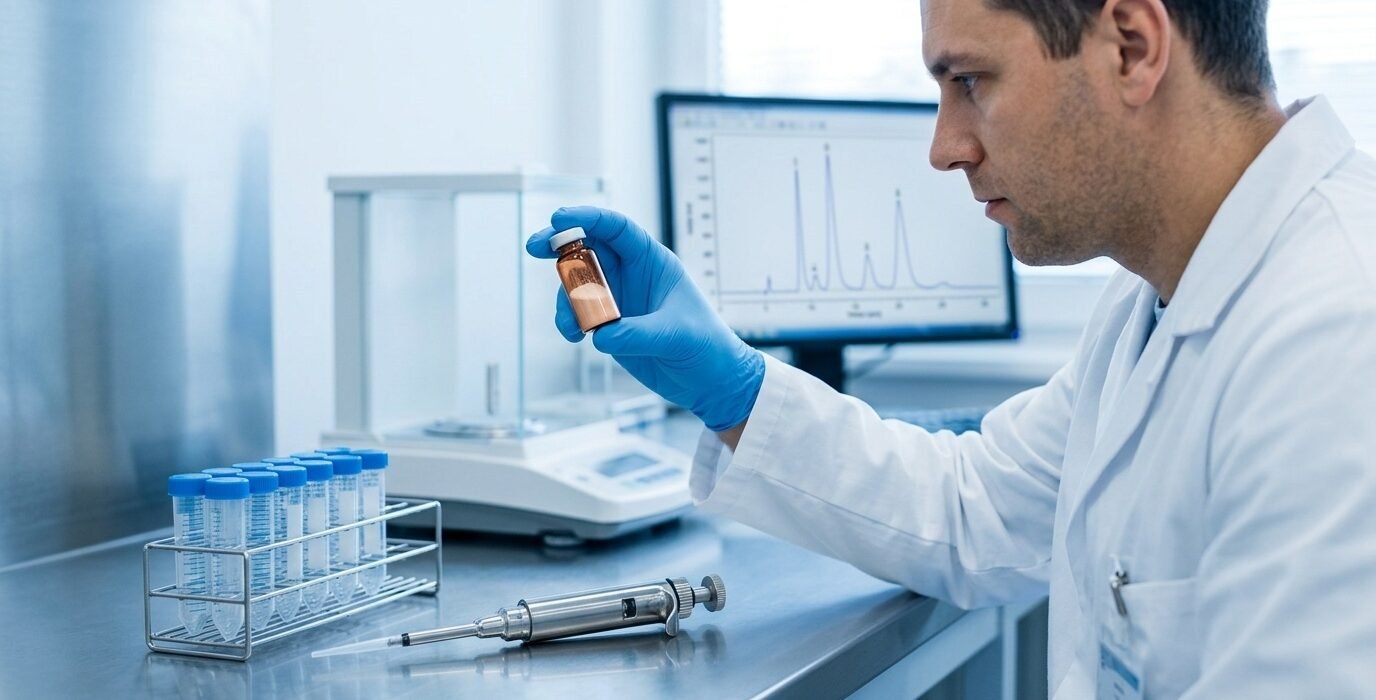
- HPLC results showing: a dominant GHK-Cu peak at 98% or higher; minor impurity peaks below 2% total; a clean chromatogram with proper peak separation; a testing date and batch number matching the vial in hand.
- Mass spectrometry confirming: molecular weight consistent with the GHK-Cu complex; a clean spectrum without unexpected mass peaks; proper ionization patterns.
- A COA that is batch-specific — generic, undated, or copy-paste documentation offers little verification value.
- Clear labeling — peptide name, sequence, purity, batch/LOT number, quantity, and storage guidance on the vial.
Key Takeaway: Never source research peptides from a supplier who cannot produce batch-specific, third-party testing documentation. The entire quality argument for GHK-Cu research rests on that paperwork.
9. Storage and Handling for Stable Research Material
GHK-Cu, like all peptides, degrades when exposed to heat, light, or improper handling. Stable handling is a core part of the quality picture:
- Lyophilized (freeze-dried) GHK-Cu should be stored under controlled cold conditions — generally −20 °C or colder — in original packaging, protected from light Canadian supplier storage guidance.
- After reconstitution, standard laboratory practice uses bacteriostatic water under sterile technique; the working solution is refrigerated at 2–8 °C for short-term use.
- Temperature excursions matter. A peptide that sits in a warm warehouse or a delivery truck for days is a different research material by the time it arrives — one of the strongest arguments for domestic sourcing.
10. Sourcing in Canada: Domestic vs. International
For Canadian laboratories, the sourcing decision is usually practical rather than scientific:
| Factor | Domestic Canadian supplier | International (typically US) supplier |
|---|---|---|
| Delivery time | 1–4 days | 1–3+ weeks |
| Customs | None | Clearance delays and inspection risk |
| Currency | CAD pricing | USD pricing plus exchange and international shipping |
| Transport stability | Minimal temperature exposure | Prolonged transit and temperature risk |
| Support | Canadian business hours | Time-zone gaps |
| Reconstitution risk window | Shorter | Longer exposure to uncontrolled conditions |
Typical price ranges in the current Canadian market run from roughly $59–$89 CAD for standard research-grade GHK-Cu with documentation depth and verification quality driving the range.
11. GHK-Cu vs. AHK-Cu: How They Compare
AHK-Cu is the most frequently asked-about relative of GHK-Cu. Both are copper-binding research peptides, but they are different molecules with different research profiles:
| GHK-Cu | AHK-Cu | |
|---|---|---|
| Sequence | Glycyl-L-histidyl-L-lysine | Alanyl-L-histidyl-L-lysine |
| Copper binding | High affinity, divalent copper | Copper-binding peptide family |
| Signaling profile | Broad — ECM remodeling, antioxidant, anti-inflammatory, gene modulation | Distinct signaling emphasis; narrower literature base |
| Literature depth | Deep, dating to the 1970s | Smaller body of published work |
For most Canadian researchers working on matrix remodeling, oxidative stress, or regenerative gene expression, GHK-Cu carries the deeper evidence base — which is exactly why it predominates in the published literature Pickart et al., 2015.
12. Regulatory Landscape and Research-Use Compliance
GHK-Cu occupies a clear regulatory position in Canada: it is a research compound, not an approved therapeutic. Canadian suppliers operate within a research-use-only framework — selling clearly labeled research materials without therapeutic claims, and including explicit notices that the product is not approved by Health Canada, the FDA, or any regulatory body for clinical or cosmetic use Canadian supplier notice.
For individual researchers, this means:
- GHK-Cu purchased for genuine laboratory research is a research material, not a medicine.
- The supplier’s responsibility is accurate labeling, documentation, and purity; the researcher’s responsibility is appropriate handling, storage, and research protocols.
- Any supplier making health, treatment, or cosmetic claims about GHK-Cu should be treated as operating outside the framework.
Did You Know: Health Canada enforcement in the peptide space focuses on companies making therapeutic claims or selling materials for human consumption — not on the legitimate research supply channel operating with proper labeling and disclaimers.
13. Future Outlook for GHK-Cu Research
The GHK-Cu field is mature but far from settled. The research directions most likely to drive new Canadian laboratory interest:
- Gene-expression work — validating and extending the transcriptome-modulation findings in defined cell systems Pickart et al., 2018.
- Stem-cell biology — the evidence base connecting GHK-Cu to stem-cell actions and the expression of relevant genes continues to grow Pickart & Margolina, 2018.
- Aging and oxidative stress — the endogenous-decline narrative keeps the peptide central to aging research Pickart et al., 2012.
- Combination and comparative studies — reviews pairing GHK-Cu with other regenerative peptides (e.g., BPC-157) point toward comparative tissue-repair research Wojcieszuk et al., 2026.
Key Takeaway: GHK-Cu is unlikely to leave Canadian laboratories anytime soon. It sits at the intersection of copper biology, matrix regulation, and gene modulation — three fields with no shortage of open questions.
Frequently Asked Questions
Is GHK-Cu approved for human use in Canada? No. GHK-Cu is not approved by Health Canada, the FDA, or any regulatory body for clinical, veterinary, or cosmetic use. It is supplied strictly for research, laboratory, and in-vitro use Canadian supplier notice.
Is it legal to buy GHK-Cu for research in Canada? Yes — research peptides sold for genuine laboratory research, without therapeutic claims, are legal to purchase and possess in Canada. The research-use-only framework places responsibility for appropriate use on the researcher Framework overview.
What is GHK-Cu, chemically? It is a tripeptide complex: glycyl-L-histidyl-L-lysine bound to copper in its divalent state (Cu²⁺). It occurs naturally in human plasma and was first identified in the early 1970s Skibska & Perlikowska, 2021.
Why do so many researchers study GHK-Cu? Because it combines copper transport with broad signaling effects — extracellular-matrix remodeling, antioxidant and anti-inflammatory pathways, and wide-ranging gene modulation — making it relevant across tissue, aging, and regenerative research Pickart et al., 2015.
How does GHK-Cu differ from AHK-Cu? Both are copper-binding tripeptides, but they differ in sequence (GHK vs. AHK) and in their signaling emphasis. GHK-Cu carries the deeper literature base and the broader regenerative signaling profile.
What purity should I look for in GHK-Cu for research? For cell-culture and animal-model research, 98% or higher HPLC purity with mass-spectrometry identity confirmation is the commonly cited standard; high-purity analytical lines reach 99% or higher Purity guidance.
How should lyophilized GHK-Cu be stored? Under controlled cold storage — typically −20 °C or colder, in original packaging, protected from light — per standard peptide-handling protocols Storage guidance.
What makes a Canadian supplier trustworthy for GHK-Cu? Batch-specific third-party COAs, HPLC and mass-spectrometry documentation, visible lab results, correct sequence verification, professional labeling with LOT tracking, and clear storage guidance — plus domestic shipping for stability.
Glossary of Terms
- GHK-Cu: A naturally occurring complex of the tripeptide glycyl-L-histidyl-L-lysine and divalent copper (Cu²⁺).
- Tripeptide: A peptide composed of three amino acids linked by peptide bonds.
- Extracellular Matrix (ECM): The structural environment surrounding cells; includes collagen, elastin, and glycosaminoglycans.
- Matrix Metalloproteinases (MMPs): Enzymes that remodel the extracellular matrix.
- Reactive Oxygen Species (ROS): Chemically reactive oxygen-containing molecules studied in oxidative-stress research.
- Cytokine: A signaling protein involved in cellular communication, including inflammatory signaling.
- HPLC (High-Performance Liquid Chromatography): An analytical method used to verify peptide purity by separating and quantifying components.
- Mass Spectrometry: An analytical technique confirming molecular identity by measuring molecular mass.
- Certificate of Analysis (COA): Batch-specific documentation from a laboratory confirming identity, purity, and quality.
- Lyophilized: Freeze-dried; the standard stable presentation for research peptides.
- Bacteriostatic Water: Sterile water preserved with 0.9% benzyl alcohol, used to reconstitute lyophilized peptides under sterile technique.
- Fibroblast / Keratinocyte: Cell types commonly studied in connective-tissue and skin regeneration research.
References
- Pickart L, et al. Regenerative and protective actions of the GHK-Cu peptide in the light of the new gene data. International Journal of Molecular Sciences. 2018. https://pmc.ncbi.nlm.nih.gov/articles/PMC6073405/
- Pickart L, Margolina A. GHK peptide as a natural modulator of multiple cellular pathways in skin regeneration. BioMed Research International. 2015. https://onlinelibrary.wiley.com/doi/pdf/10.1155/2015/648108
- Pickart L, Vasquez-Soltero JM, Margolina A. The human tripeptide GHK-Cu in prevention of oxidative stress and degenerative conditions of aging: implications for cognitive health. Oxidative Medicine and Cellular Longevity. 2012. https://onlinelibrary.wiley.com/doi/abs/10.1155/2012/324832
- Pickart L, Margolina A. The effect of the human plasma molecule GHK-Cu on stem cell actions and expression of relevant genes. OBM Geriatrics. 2018. https://www.lidsen.com/journals/geriatrics/geriatrics-02-03-009/
- Skibska A, Perlikowska R. Signal peptides — promising ingredients in cosmetics. Current Protein and Peptide Science. 2021. https://www.benthamdirect.com/content/journals/cpps/10.2174/1389203722666210812121129
- Wojcieszuk O, et al. BPC-157 and GHK-Cu in wound healing and tissue repair: A review of clinical efficacy and safety. Quality in Sport. 2026. https://apcz.umk.pl/QS/article/view/70818
- Maquart FX, et al. Glycyl-L-histidyl-L-lysine stimulates collagen synthesis in fibroblast cultures. FEBS Letters. 1988.
- Health Canada. Drug Product Database. Government of Canada. https://www.canada.ca/en/health-canada/services/drugs-health-products/drug-products/drug-product-database.html
Research Use Notice: All information in this article is provided for scientific, educational, and laboratory reference only. GHK-Cu is intended strictly for research, laboratory, and in-vitro use and is not approved for human or veterinary consumption, nor as a cosmetic ingredient under Canadian regulation. This article is not medical advice.