
Peptides in Canada: What They Are, Current Research, and Safety
A research-focused guide to peptides for Canadian readers — what peptides are, how the body uses them, where the evidence actually stands for popular injectable peptides like BPC-157, GHK-Cu, and TB-500, and what Health Canada’s current regulatory position says about them.
Quick answer
Peptides are short chains of amino acids that the body makes on its own to coordinate functions ranging from blood-sugar regulation to tissue repair. A small number of peptide-based medications — most notably the GLP-1 receptor agonists semaglutide (Ozempic, Wegovy) and tirzepatide (Zepbound, Mounjaro) — are authorized by Health Canada for specific indications. A much larger group of injectable peptides being promoted online and in clinics — including BPC-157, GHK-Cu, and TB-500 — are not authorized by Health Canada for human or veterinary use and are framed in Canada’s regulatory system as unauthorized prescription drugs, not as research compounds available for self-directed administration Health Canada advisory.
Table of Contents
- What Are Peptides and How Do They Work?
- Peptides the Body Makes — and Why That Matters
- Peptide-Based Medications Health Canada Has Authorized
- The Trending Peptides: BPC-157, GHK-Cu, TB-500, and Others
- The Research-Use Pathway and What It Means for Canadian Labs
- Frequently Asked Questions
- Glossary
- References
1. What Are Peptides and How Do They Work?
Peptides are short chains of amino acids — the same building blocks that make up proteins — but typically much shorter. Where a protein might contain hundreds of amino acids folded into a complex three-dimensional structure, a peptide is usually a few to a few dozen amino acids in a relatively simple chain.
That structural simplicity is misleading. Peptides act as highly specific signaling molecules: each peptide sequence binds to a particular receptor, enzyme, or transport system and produces a particular biological effect. The body produces its own peptides to coordinate hormone activity, immune defense, tissue repair and growth, inflammation control, and digestion, among many other functions Harvard Health Publishing.
Peptides can be made three ways:
- Endogenously — by the body’s own ribosomes, often as larger precursor proteins that are later cleaved into the active peptide.
- From dietary protein — digestive enzymes break down meat, eggs, legumes, and dairy into peptide fragments, some of which are themselves biologically active.
- Synthetically — laboratory peptide synthesis (solid-phase peptide synthesis is the most common technique) enables the production of peptides identical to endogenous ones, modified analogues, or entirely novel sequences.
The category is broad. Insulin is a peptide. Endorphins are peptides. Collagen fragments circulating in blood are peptides. Many research compounds — including the BPC-157, GHK-Cu, and TB-500 families discussed later in this article — are also peptides, though they have very different biological roles and very different evidence profiles.
2. Peptides the Body Makes — and Why That Matters
Some of the body’s own peptides are exactly the compounds the pharmaceutical industry has learned to synthesize:
| Endogenous peptide | Made by | Main function |
|---|---|---|
| Insulin | Pancreatic β-cells | Regulates blood glucose |
| Endorphins | Central nervous system | Block pain signals, modulate stress |
| Growth-hormone-releasing hormone (GHRH) | Hypothalamus | Triggers pituitary release of growth hormone |
| GLP-1 (glucagon-like peptide-1) | Gut L-cells | Stimulates insulin secretion, suppresses glucagon, slows gastric emptying |
| BPC-157 (Body Protection Compound-157) | Originally isolated from gastric juice | Studied in animal models for cytoprotective and tissue-repair effects — see Section 4 |
| GHK-Cu | Plasma (a natural copper-binding tripeptide) | Studied for extracellular-matrix remodeling and gene modulation — see Section 4 |
The last two rows are where the line between “what the body makes” and “what online wellness channels sell” gets blurry. BPC-157 was originally isolated from gastric juice, and GHK-Cu was first identified in human plasma in the early 1970s. Both are now widely sold online as synthetic analogues — a category mix-up that is at the heart of much of the regulatory confusion around these products.
3. Peptide-Based Medications Health Canada Has Authorized
The peptide therapeutics currently authorized by Health Canada cluster in three groups.
GLP-1 receptor agonists — the most prominent category for Canadian readers. According to Health Canada’s Drug Product Database summaries, the following products are approved for specific indications:
| Drug (Brand) | Health Canada–approved indication(s) |
|---|---|
| Semaglutide (Ozempic, Rybelsus, Wegovy) | Type 2 diabetes (Ozempic, Rybelsus); chronic weight management (Wegovy) |
| Tirzepatide (Mounjaro, Zepbound) | Type 2 diabetes (Mounjaro); chronic weight management (Zepbound) |
| Dulaglutide (Trulicity) | Type 2 diabetes |
| Liraglutide (Victoza, Saxenda) | Type 2 diabetes (Victoza); chronic weight management (Saxenda) |
Note that the same compound can be marketed under different brand names with different approved indications. Off-label use of any of these products is a clinical decision between a patient and a licensed Canadian prescriber, not a research or self-directed question Table of GLP-1 RA Products Approved in Canada — NCBI/NIH.
Insulin and insulin analogues — the entire clinical insulin family (rapid-, short-, intermediate-, and long-acting) is peptide-based. These are well-established Health Canada–authorized prescription drugs.
Other authorized peptide products — calcitonin (for bone resorption), glucagon (for severe hypoglycemia), desmopressin (for diabetes insipidus and certain bleeding disorders), and a small number of others occupy well-defined regulatory niches.
This is the bright line in the Canadian regulatory map: a peptide is either a Health Canada–authorized prescription medication for a specific indication, or it is not. There is no third category in which an injectable peptide can be sold for general wellness or self-administration Health Canada advisory.
4. The Trending Peptides: BPC-157, GHK-Cu, TB-500, and Others
The peptides generating the most online attention — and the most regulatory attention — in Canada at present are a short list of compounds being marketed for performance, recovery, and “anti-aging” outcomes.
- BPC-157 — a synthetic pentadecapeptide originally isolated from gastric juice. Marketed claims include faster healing, reduced inflammation, gut protection, and tendon/ligament recovery.
- GHK-Cu — the copper-binding tripeptide complex described in detail in our GHK-Cu Canada research guide. Marketed claims include collagen support, skin rejuvenation, hair-restoration effects, and “anti-aging” gene modulation.
- TB-500 (thymosin β-4 fragment) — a synthetic fragment of a naturally occurring actin-binding peptide. Marketed primarily for muscle recovery, flexibility, and injury healing.
- CJC-1295, Ipamorelin, and other “growth-hormone-releasing” peptides — promoted for body composition, sleep, and recovery by stimulating endogenous growth-hormone release.
- “K-low” or “blend” products — compounded mixtures that combine several of the above (for example, BPC-157 + TB-500 + GHK-Cu + KPV), marketed as convenience formulations.
- Retatrutide, MOTS-c, KPV, NAD+, and others — additional compounds circulating in the same online channels with varying levels of published evidence and varying levels of regulatory enforcement.
5. The Research-Use Pathway and What It Means for Canadian Labs
There is a parallel and lawful pathway for accessing many of these peptides in Canada: the research-use-only supply channel that serves Canadian academic, biotech, and industrial laboratories. Reputable Canadian research suppliers sell lyophilized peptides with batch-specific Certificates of Analysis, third-party HPLC purity testing, mass-spectrometry identity confirmation, and clear labelling — under the standing policy that the material is for in-vitro and laboratory research use only, not for human or veterinary administration.
This pathway is the source of supply for our GHK-Cu Canada research guide, and the same framework applies to BPC-157, TB-500, CJC-1295, Ipamorelin, and other peptides with active research programs. The peptide itself is the same molecule that is available in the broader market; what differs is the regulatory framework that applies — research-use supply is a legitimate, well-documented channel. Human-use supply of these same compounds outside the prescription-drug framework is the channel Health Canada has been actively warning against.
For Canadian researchers, the takeaway is that the research-supply channel is preserved and well-served.
6. Frequently Asked Questions
Are peptides legal in Canada? That depends on the peptide, the indication, and the regulatory framework. Health Canada has authorized a small number of peptide medications (insulin, semaglutide, tirzepatide, and others) for specific indications, available by prescription through licensed Canadian pharmacies. Health Canada has not authorized most of the injectable peptides being marketed online — including BPC-157, GHK-Cu, TB-500, CJC-1295, and Ipamorelin — for any human or veterinary use Health Canada advisory.
Is research-use-only labelling a loophole? No. A product labelled “for research use only” is not a Health Canada–authorized medication, and the research-use designation does not authorize human use. Health Canada has explicitly addressed this framing in its public advisory Health Canada advisory.
How does Health Canada decide what is approved? Health Canada evaluates new drugs through the same evidence framework used by other major regulators: preclinical data, phased clinical trials, manufacturing-quality documentation, and post-market surveillance. Approval requires that benefits be demonstrated to outweigh risks for the specific indication requested.
Can a Canadian doctor prescribe BPC-157 or GHK-Cu? A licensed Canadian prescriber may write a prescription for a compounded peptide product. Whether a pharmacy can lawfully compound and dispense that prescription depends on whether the underlying substance is appropriate for compounding under Canadian pharmacy regulations, and whether the prescription meets the standards of care for the condition being treated. Reputable compounding pharmacies operate within this framework; selling the same compounds without a prescription, for general “wellness” use, is not within it.
Are dietary peptide supplements different from injectable peptides? Yes, both in regulatory category and in risk profile. Dietary peptide supplements — collagen, creatine, certain plant-derived peptides — fall under the Natural Health Products Regulations when properly licensed, with an NPN on the label, and are reviewed by Health Canada’s Natural and Non-prescription Health Products Directorate Health Canada NHP regulation overview. These are oral and topical products, not injectable, and the regulatory framework reflects that difference.
What about semaglutide and tirzepatide — can Canadians buy them without a prescription? No. Both are Schedule prescription drugs in Canada, available only with a prescription from a licensed Canadian prescriber and dispensed by a licensed Canadian pharmacy. Health Canada has issued a specific public advisory warning Canadians about unauthorized GLP-1 products being sold online Health Canada GLP-1 advisory.
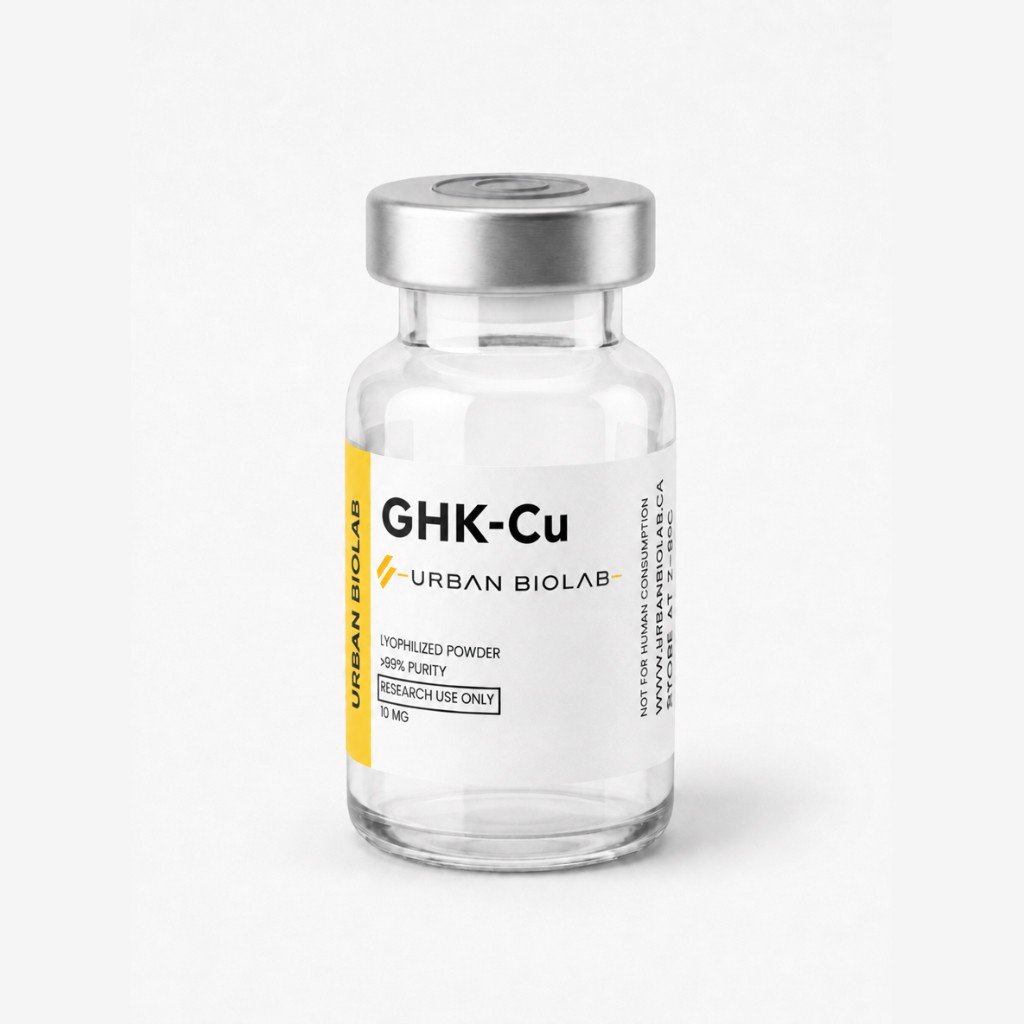
GHK-Cu 80MG
GHK-Cu 50mg is a copper-binding research peptide complex widely studied for its role in cellular signaling, tissue remodeling, and regenerative biology pathways. In laboratory research settings, GHK-Cu has attracted interest for investigations into wound-healing models, collagen synthesis pathways, and antioxidant activity, making it a valuable compound in skin, tissue, and cellular regeneration research.
7. Glossary
- Amino acid — The fundamental building block of peptides and proteins. Twenty standard amino acids are encoded by human DNA.
- Peptide — A short chain of amino acids, typically a few to a few dozen residues, linked by peptide bonds.
- Protein — A longer chain of amino acids (typically hundreds or thousands), folded into a specific three-dimensional structure.
- GLP-1 receptor agonist — A class of peptide-based drugs (including semaglutide and tirzepatide) that mimic the action of endogenous GLP-1 to lower blood glucose and reduce appetite.
- DIN (Drug Identification Number) — An eight-digit number assigned by Health Canada to every prescription and over-the-counter drug product authorized for sale in Canada.
- NPN (Natural Product Number) — The corresponding identifier for natural health products licensed by Health Canada under the Natural Health Products Regulations.
- Compounding pharmacy — A licensed pharmacy that prepares customized medications for individual patients with valid prescriptions, including customized peptide formulations where regulations permit.
- HPLC (High-Performance Liquid Chromatography) — An analytical technique used to verify peptide purity by separating and quantifying components.
- Mass spectrometry — A complementary analytical technique that confirms peptide molecular identity by measuring mass.
- Certificate of Analysis (COA) — Batch-specific documentation from an analytical laboratory confirming identity, purity, and other quality parameters.
- Lyophilized — Freeze-dried; the standard stable presentation format for research-grade peptides.
- In-vitro — Literally “in glass”; laboratory work performed in controlled cell-culture or tissue systems, outside a whole living organism.
- Pharmacokinetics — What the body does to a drug: absorption, distribution, metabolism, and elimination.
- Pharmacodynamics — What a drug does to the body: the mechanism of action and the dose-response relationship.
8. References
- Health Canada. Think twice before injecting peptides bought online — unauthorized products can seriously harm you [Public advisory]. Government of Canada. https://recalls-rappels.canada.ca/en/alert-recall/think-twice-injecting-peptides-bought-online-unauthorized-products-can-seriously-harm
- Health Canada. Unauthorized injectable peptide drugs seized from Optimum Wellness Centre, Calgary, Alberta [Recall notice]. Government of Canada. https://recalls-rappels.canada.ca/en/alert-recall/unauthorized-injectable-peptide-drugs-seized-optimum-wellness-centre-calgary-alberta
- Health Canada. Thinking about buying GLP-1 drugs like Ozempic or Mounjaro — beware of fake or unauthorized products [Public advisory]. Government of Canada. https://recalls-rappels.canada.ca/en/alert-recall/thinking-about-buying-glp-1-drugs-ozempic-or-mounjaro-beware-fake-or-unauthorized
- CBC News. Health Canada warns against injecting unauthorized drugs promoted as ‘peptides’ [News report]. Canadian Broadcasting Corporation. https://www.cbc.ca/news/health/health-canada-peptides-injecting-unauthorized-drugs-9.7158178
- Health Canada. Natural health product regulation in Canada: Overview [Regulatory overview]. Government of Canada. https://www.canada.ca/en/health-canada/services/drugs-health-products/natural-non-prescription/regulation.html
- National Center for Biotechnology Information. Table 6, GLP-1 RA Products Approved in Canada [NIH Bookshelf reference]. U.S. National Library of Medicine. https://www.ncbi.nlm.nih.gov/books/NBK603325/table/t06/
- Pickart L, et al. (referenced in companion article). Regenerative and protective actions of the GHK-Cu peptide in the light of the new gene data. International Journal of Molecular Sciences. 2018. https://pmc.ncbi.nlm.nih.gov/articles/PMC6073405/
- McGuire FP, Martinez R, Lenz A, Skinner L, et al. Regeneration or risk? A narrative review of BPC-157 for musculoskeletal healing. Current Reviews in Musculoskeletal Medicine. 2025. https://link.springer.com/article/10.1007/s12178-025-09990-7
- DeFoor MT, Dekker TJ. Injectable therapeutic peptides — An adjunct to regenerative medicine and sports performance? Arthroscopy. 2025. https://arthroscopyjournals.onlinelibrary.wiley.com/doi/abs/10.1016/j.arthro.2024.09.005
- Pietrzyk B, Waluga M. BPC-157 and the gut–brain axis: emerging links between cytoprotection and neuroregeneration. Annales Academiae Medicae Silesiensis. 2026. https://bibliotekanauki.pl/articles/64149067.pdf
- Wojcieszuk O, Starczewski Ł, Babik A, Kamińska K, et al. BPC-157 and GHK-Cu in wound healing and tissue repair: A review of clinical efficacy and safety. Quality in Sport. 2026. https://apcz.umk.pl/QS/article/view/70818
- Harvard Health Publishing. Peptides: What they are, potential benefits, and safety concerns [Patient-education article]. Harvard Medical School. https://www.health.harvard.edu/medications-and-treatments/peptides-what-they-are-potential-benefits-and-safety-concerns
Research Use & Medical Disclaimer
This article is intended for educational, research, and laboratory reference only. It is not medical advice, and nothing on this page is a substitute for consultation with a licensed Canadian healthcare provider. None of the peptides discussed in this article — except those explicitly identified as Health Canada–authorized prescription products — have been approved by Health Canada for any human use. Do not inject any peptide without a valid prescription from a licensed Canadian prescriber and supply from a licensed Canadian pharmacy. Research-use supply is the appropriate Canadian channel for laboratory and in-vitro work, not for human or veterinary administration.