Research-led, supplier-neutral guide to evaluating GHK-Cu in Canada — what the compound is, what the published evidence actually supports, how to read a Certificate of Analysis, how to vet a Canadian research supplier, and what Health Canada’s regulatory position means for buyers.
QUICK ANSWER
GHK-Cu is a copper-binding tripeptide complex — glycyl-L-histidyl-L-lysine bound to copper(II) — that occurs naturally in human plasma and has been the subject of laboratory research for decades. Preserved Canadian suppliers sell it as lyophilized research-grade material; Health Canada has not approved GHK-Cu for therapeutic use, and no Health Canada DIN is associated with the compound. For Canadian researchers, the relevant decisions are not “which brand” but how to evaluate a supplier against an evidence-anchored standards framework — independent third-party testing, batch-specific Certificate of Analysis, ≥99% HPLC purity with mass-spectrometry identity confirmation, and transparent storage and shipping practices. This guide walks through that framework without endorsing any specific supplier.
Table of Contents
- What GHK-Cu Is (and What It Is Not)
- The Copper(II) Connection — Why It Matters Structurally
- The Published Evidence: Mechanism and Known Effects
- Forms, Vial Sizes, and Presentation — What Canadian Buyers Should Understand
- Purity Standards: HPLC, Mass Spectrometry, and Other Specifications
- The Certificate of Analysis — Reading It Like a Researcher
- Quality Red Flags — What Disqualifies a Supplier
- Reconstitution and Storage in the Lab
- Canadian Regulatory Status — What Health Canada Actually Says
- The “Research Use Only” Framing — How to Read It Correctly
- Vetting a Canadian Supplier: An Evidence-Anchored Checklist
- Frequently Asked Questions
- Glossary
- References
- Disclaimer
1. What GHK-Cu Is (and What It Is Not)
GHK-Cu is a small, naturally occurring peptide complex. The peptide half is glycyl-L-histidyl-L-lysine — three amino acids joined by peptide bonds. The “Cu” half is a single copper(II) ion held by the peptide in a high-affinity coordination complex. Together they form a single research object: a tripeptide-metal complex that behaves differently from the bare amino-acid sequence alone.
Two clarifications that matter when you read marketing copy:
- GHK is not GHK-Cu. The copper-free tripeptide (often sold separately for some research applications) and the copper-bound complex are different compounds with different physicochemical properties. Most of the published mechanism literature is on the copper-bound form. When a supplier’s literature says “GHK-Cu specifically” but ships a product whose Certificate of Analysis does not confirm copper content, that is a discrepancy worth flagging.
- GHK-Cu is not human-use-approved. Health Canada, the FDA, and equivalent regulators have not authorized GHK-Cu for any therapeutic indication Health Canada public advisory on unauthorized injectable peptides. The compound is sold in Canada through a research-use-only supply channel and is not a prescription drug, an over-the-counter medication, or a licensed natural health product (no NPN).
2. The Copper(II) Connection — Why It Matters Structurally
The copper ion in GHK-Cu is bound, not free. That difference matters in three ways:
- The complex is biologically active in a way the bare tripeptide is not. Coordination of Cu(II) by GHK changes the compound’s redox behavior, receptor interactions, and stability in solution. Most GHK-Cu mechanism research is mechanism-on-the-complex, not mechanism-on-the-bare-peptide.
- Gene-expression effects depend on the copper. The 2018 Pickart et al. gene-expression analysis reports that GHK-Cu modulates large numbers of genes associated with tissue repair, inflammation, and antioxidant defense. The published literature credits the copper-bound form with these properties.
- Purity claims should cover the complex, not just the sequence. A Certificate of Analysis that confirms peptide sequence but omits copper content is incomplete. Buy-direction-relevant third-party testing should explicitly report both.
3. The Published Evidence: Mechanism and Known Effects
What the peer-reviewed literature actually supports — and where it does not.
Strong support: in-vitro and cell-culture mechanisms.
- Extracellular-matrix remodeling. GHK-Cu has been studied for its influence on collagen synthesis, elastin-related pathways, glycosaminoglycan production, and matrix metalloproteinase (MMP) regulation. The foundational collagen synthesis finding dates to Maquart et al. (1988, FEBS Letters).
- Broad gene-expression modulation. Pickart L. and colleagues have reported, in their 2018 gene-data paper (Int. J. Mol. Sci.), that GHK-Cu modulates expression of large numbers of genes involved in tissue repair, inflammation, and antioxidant response.
- Cellular regeneration and migration. Fibroblast and keratinocyte behavior, plus regenerative signaling markers, are documented in the skin-biology literature.
Peer-reviewed reviews (2025–2026) explicitly flag the gap between preclinical and human evidence. A 2025 review in Current Reviews in Musculoskeletal Medicine catalogues both theoretical mechanisms and reported adverse events for BPC-157 alongside related tissue-repair peptides, and a 2025 Arthroscopy editorial by DeFoor and Dekker explicitly states that “we do not recommend the use of BPC-157 for sports … testing is limited in efficacy,” underscoring the gap between in-vitro findings and intervention-grade evidence. For GHK-Cu specifically, the 2026 Quality in Sport review (Wojcieszuk et al.) reaches a parallel conclusion: animal-model and in-vitro evidence is supportive, but human-trial data remains thin.
Where claims go beyond the evidence. Compound-specific marketed claims circulating on social media — such as “boost athletic performance,” “enhance sexual function,” or “support anti-aging” as broad human outcomes — are not supported by the human-trial evidence base at present. The relevant evidentiary category is preclinical mechanistic work; whether those mechanisms translate to human outcomes is an open question the published literature has not closed.
| Claim category | In-vitro / animal data | Human-trial data | Authoritative position |
|---|---|---|---|
| Gene-expression modulation | Yes (multiple peer-reviewed studies) | Limited/inconclusive at human-trial scale | Defensible as a research direction |
| ECM / collagen remodeling | Yes (foundational paper + 5-decade literature) | Limited controlled-trial data | Defensible for laboratory research |
| Antioxidant / anti-inflammatory | Yes (ROS regulation, cytokine work) | Limited/inconclusive | Defensible for laboratory research |
| Human athletic-performance enhancement | Limited preclinical evidence | Not established | Not supported as a clinical claim |
| Broad human “anti-aging” outcome | Speculative extrapolation | Not established | Not supported as a clinical claim |
4. Forms, Vial Sizes, and Presentation — What Canadian Buyers Should Understand
Research-grade GHK-Cu in Canada is typically supplied as lyophilized (freeze-dried) powder in sealed vials. Common vial sizes on the Canadian research market are in the range of 10 mg and 50 mg; the practical differences:
| Vial size | Practical implications for a researcher |
|---|---|
| ~10 mg | Suited to short, low-throughput experiments; multiple vials may be needed for extended protocols |
| ~50 mg | Suited to longer or multi-experiment protocols; fewer reconciliation events in lab documentation |
The 50 mg presentation is not a quality differentiator on its own. What matters is what the third-party testing on each vial says about purity, molecular identity, and contaminants.
5. Purity Standards: HPLC, Mass Spectrometry, and Other Specifications
The published guidance for research-grade peptides converges on a short standards list:
| Specification | Research-grade standard | Why it matters |
|---|---|---|
| HPLC purity | ≥ 98% for cell-culture / animal-model work; ≥ 99% for high-purity analytical research | Higher purity reduces confounding impurity peaks and improves reproducibility |
| Mass spectrometry (MS) identity confirmation | Required | Confirms molecular identity, not just absence of impurities |
| Copper content | Reported (typically trace-element analysis) | Confirms the copper-bound form, not only the bare peptide sequence |
| Endotoxin / bioburden | Ideally reported (especially for cell-culture work) | Confirms suitability for biological assays |
| Counter-ion / salt form | Reported (acetate, chloride, etc.) | Affects solubility and storage behavior |
A specification that meets these criteria should be documented on a batch-specific Certificate of Analysis — not a generic, templated, or undated document.
6. The Certificate of Analysis — Reading It Like a Researcher
A COA is only as useful as the questions it answers. Researchers evaluating a COA should look for:
- Testing date — recent enough to be meaningful (peptide purity can drift with storage time).
- Method and instrument — HPLC and MS methods should be named, not redacted.
- Numerical results, not vague language — “≥99% purity by HPLC” is a useful statement; “high purity” is not.
- Chromatogram and spectrum figures — visual confirmation of method quality. A clean HPLC chromatogram should show a single dominant peak with well-separated minor peaks; a clean MS spectrum should show a molecular-ion mass consistent with the GHK-Cu complex.
- Third-party identification — testing performed by an independent laboratory, not the supplier itself.
The COA’s value to a researcher is exactly proportional to its specificity and recency, and to the independence of the lab that produced it.
7. Quality Red Flags — What Disqualifies a Supplier
Patterns in the Canadian and adjacent research-supply market that the peer-reviewed literature and Health Canada consistently flag against:
- Sequenced-only testing, no MS confirmation. Mass spectrometry confirms identity; without it, any peptide of similar molecular weight could pass.
- No third-party identification. When the supplier is also the testing lab, the verification loop is circular. Reputable setups name an independent third-party analytical laboratory.
- Therapeutic or cosmetic claims on the product page. The research-use-only framing is incompatible with health or efficacy claims. A supplier making human-benefit claims about GHK-Cu is operating outside the Canadian research-only framework.
- Missing or vague country-of-origin disclosure for the synthesis. A peptide synthesized under cGMP conditions with full documentation is meaningfully different from one sourced from an unknown synthesis chain.
8. Reconstitution and Storage in the Lab
Reproducible results begin with reproducible handling. Standard practice for research-purpose GHK-Cu:
- Store lyophilized powder cold and dry — typically at −20 °C or below, in original sealed packaging, protected from light.
- Reconstitute with bacteriostatic water under sterile technique, in a clean working environment.
- Refrigerate the working solution at 2–8 °C for short-term use; protect from light and limit freeze-thaw cycles.
- Plan reconstitution volumes by anticipated per-experiment needs — researcher community guidance commonly cites stable use of reconstituted GHK-Cu for up to about 28 days under refrigeration, though individual protocols vary.
These are conventions, not regulated standards. Researchers are responsible for their own protocol design and verification.
9. Canadian Regulatory Status — What Health Canada Actually Says
Three points worth pinning down:
- Health Canada has not approved GHK-Cu for any human therapeutic use. The compound does not carry a Drug Identification Number (DIN).
- Health Canada has not licensed GHK-Cu as a natural health product. No NPN exists for injectable GHK-Cu in the Canadian market, and the Natural Health Products Regulations apply to oral/topical products originally — not to injectable peptides.
- Health Canada has publicly warned against purchasing injectable peptides online for general use. A standing public advisory treats most injectable peptides (BPC-157, GHK-Cu, TB-500, CJC-1295, Ipamorelin, and others) as unauthorized products that “can seriously harm you.”
The Canadian regulatory picture therefore has three categories a buyer needs to keep mentally separate:
- Health Canada–authorized prescription drugs for specific indications (insulin, semaglutide, tirzepatide, others) — dispensed through licensed Canadian pharmacies only.
- Health Canada–licensed natural health products (collagen, certain creatine, plant-derived peptides when properly licensed) — sold in oral or topical form, with an NPN on the label.
- Research-grade research-use-only supply — distributed by Canadian research suppliers under a labelling and documentation regime that places the compound in the laboratory, not in clinical use.
10. The “Research Use Only” Framing — How to Read It Correctly
“Research use only” is a category of the third regulatory line above, not a Health Canada endorsement. Vendors that legitimately serve the research-use supply channel label their products accordingly and back the label with batch-specific testing documentation. That framing is appropriate for laboratory and in-vitro research applications; it is not a license to administer the compound to humans or animals, and it does not make the underlying substance approved, licensed, or sale-eligible as a medication.
For Canadian consumers who are not researchers, the practical upshot is: a “research use only” label does not legitimize a non-prescription retail channel for human use. Health Canada’s enforcement record — including seizure notices against specific Canadian retailers selling unauthorized injectable peptides — applies to the supply chain as well as to the consumer-facing side.
11. Vetting a Canadian Supplier: An Evidence-Anchored Checklist
This is the section to apply directly when choosing a supplier. Use it as a binary list — every item should be verifiable from the supplier’s website, product page, and accompanying paperwork; any unmet item weakens the case.
Documentation
- A batch-specific Certificate of Analysis is published or available on request, including testing date.
- HPLC purity ≥ 98% (≥ 99% for high-purity lines) is reported on the COA.
- Mass-spectrometry identity confirmation is reported on the COA, with a molecular-ion mass consistent with the GHK-Cu complex.
- The third-party analytical laboratory is named and independent of the supplier.
Lab-results transparency
- The supplier maintains a public lab-results page that is updated as batches ship.
- Chromatograms and spectra are visible — not just numerical claims.
- COAs are dated and LOT-specific.
Quality systems
- Manufacturing method is named (commonly solid-phase peptide synthesis, SPPS).
- Manufacturing location and country are disclosed.
- Storage and chain-of-custody documentation is consistent.
Canadian-domestic considerations
- Operational base and shipping origin are in Canada.
- Pricing is presented in Canadian dollars.
- Shipping does not route through customs (i.e., origin is within Canadian borders).
- Reasonable and honest disclosure of shipping speed and conditions is on the product page.
Regulatory framing
- Product label and product page do not make therapeutic or cosmetic claims about GHK-Cu outcomes.
- The supplier explicitly disclaims human and veterinary use.
- The supplier uses language consistent with the research-use-only framework rather than positioning the product as a medication.
Operational sanity checks
- Return / refund policy is published.
- Privacy policy and terms of service are published.
A supplier that meets all (or nearly all) of the above gives a researcher a defensible starting position; a supplier that fails several items — particularly around independent third-party testing, batch-specific COAs, and absence of human-use claims — is a poor choice regardless of price.
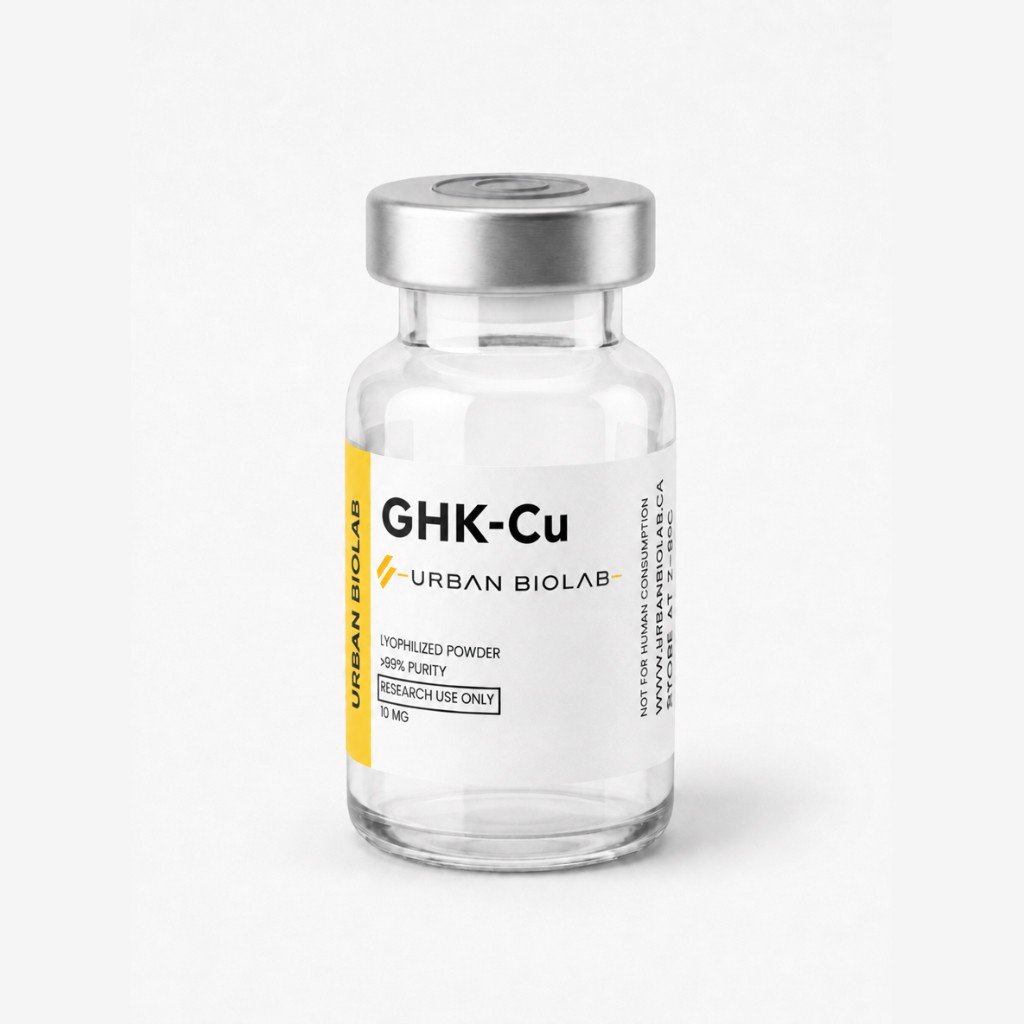
GHK-Cu 80MG
GHK-Cu 50mg is a copper-binding research peptide complex widely studied for its role in cellular signaling, tissue remodeling, and regenerative biology pathways. In laboratory research settings, GHK-Cu has attracted interest for investigations into wound-healing models, collagen synthesis pathways, and antioxidant activity, making it a valuable compound in skin, tissue, and cellular regeneration research.
12. Frequently Asked Questions
What is GHK-Cu? A tripeptide (glycyl-L-histidyl-L-lysine) bound to a copper(II) ion. Naturally occurring in human plasma, saliva, and urine; studied in laboratory and animal-model research for decades.
Is GHK-Cu the same as “copper peptides” in cosmetic products? “Copper peptide” is a category that includes GHK-Cu and several related compounds. Cosmetic-product use of copper peptides is a different regulatory and evidence framework, governed by cosmetic regulation rather than the research-use-only framework that applies to laboratory supply. When a research supplier says “GHK-Cu,” they specifically mean the tripeptide-Cu(II) complex of GHK.
Is GHK-Cu approved by Health Canada or the FDA? No. Health Canada has not authorized GHK-Cu for any therapeutic use; the FDA likewise. Health Canada has issued a public advisory explicitly warning against unauthorized injectable peptide products Health Canada public advisory.
What is research-use only? A category of supply for in-vitro and laboratory research applications. It is not an approval pathway, not a license to administer the compound to humans or animals, and not a Health Canada endorsement. Suppliers operating in this category sell batch-tested material with documentation; consumers should understand the framing as a regulatory route for lab supply, not for clinical use.
What purity should I require? At minimum ≥ 98% HPLC purity with mass-spectrometry identity confirmation for general cell-culture and animal-model work; ≥ 99% is reasonable for high-purity analytical research. The standard should be verified on every batch via a batch-specific COA.
Should I buy from a Canadian or international supplier? The case for a Canadian-based supplier is operational, not regulatory. Domestic supply shortens shipping distance (relevant for cold-chain peptide stability), avoids customs friction, and presents pricing in Canadian dollars. The case for vetting remains the same regardless of country of origin.
Can GHK-Cu be combined with other research peptides? Combination protocols exist in the published laboratory literature (e.g., GHK-Cu alongside BPC-157 in wound-healing and tissue-repair reviews). However, combination-specific human evidence is not established at clinical-trial scale; researchers designing combination protocols do so on the basis of independent literature and their own experimental design, not a published combination-grade recommendation.
Does vial size matter for research quality? No. Vial size is a packaging choice, not a quality signal. What matters is that every vial, regardless of size, has a matching batch-specific COA.
How long is reconstituted GHK-Cu stable? Routine research-grade guidance supports refrigerated (2–8 °C) storage of reconstituted peptide for approximately up to 28 days under standard sterile-handling conditions. Stability depends on handling, container, and other protocol-specific factors; researchers should validate stability for their own use case.
13. Glossary
- GHK-Cu — A tripeptide-copper(II) complex of glycyl-L-histidyl-L-lysine.
- Tripeptide — A peptide composed of three amino acids linked by peptide bonds.
- Copper(II) / Cu(II) — The divalent oxidation state of copper, the form bound in the GHK-Cu complex.
- Lyophilized (freeze-dried) — The standard stable presentation for research peptides, with water removed by sublimation.
- HPLC (High-Performance Liquid Chromatography) — Analytical method used to verify peptide purity.
- Mass spectrometry (MS) — Analytical method that confirms molecular identity by measuring molecular-ion mass.
- Certificate of Analysis (COA) — Batch-specific documentation from an analytical laboratory confirming identity, purity, and other quality measurements.
- Endotoxin / bioburden — Tests for bacterial contamination relevant to cell-culture and biological-assay work.
- DIN (Drug Identification Number) — Health Canada’s identifier for authorized prescription drugs.
- NPN (Natural Product Number) — Health Canada’s identifier for licensed natural health products.
- Solid-phase peptide synthesis (SPPS) — Standard laboratory method for synthesizing peptides.
- In-vitro — Laboratory work in controlled cell-culture or tissue systems, outside a whole living organism.
- Pharmacokinetics / pharmacodynamics — How the body processes a substance, and how the substance acts on the body, respectively.
- cGMP — Current Good Manufacturing Practice, the manufacturing-quality framework applicable to pharmaceutical-grade production.
14. References
- Pickart L, Margolina A. Regenerative and Protective Actions of the GHK-Cu Peptide in the Light of the New Gene Data. Int. J. Mol. Sci. 2018;19(7):1987. https://www.mdpi.com/1422-0067/19/7/1987
- Pickart L, Margolina A. The Human Tri-Peptide GHK and Tissue Remodeling. J. Biomater. Sci. Polym. Ed. 2008;19(8):969-988.
- Pickart L, Vasquez-Soltero JM, Margolina A. GHK Peptide as a Natural Modulator of Multiple Cellular Pathways in Skin Regeneration. BioMed Research International. 2015;2015:648108.
- Pickart L, Vasquez-Soltero JM, Margolina A. The Human Tripeptide GHK-Cu in Prevention of Oxidative Stress and Degenerative Conditions of Aging. Oxidative Medicine and Cellular Longevity. 2012;2012:324832. https://onlinelibrary.wiley.com/doi/abs/10.1155/2012/324832
- Maquart FX, et al. Glycyl-L-Histidyl-L-Lysine stimulates collagen synthesis in fibroblast cultures. FEBS Letters. 1988.
- Wojcieszuk O, Starczewski Ł, Babik A, Kamińska K et al. BPC-157 and GHK-Cu in wound healing and tissue repair: A review of clinical efficacy and safety. Quality in Sport. 2026. https://apcz.umk.pl/QS/article/view/70818
- McGuire FP, Martinez R, Lenz A, Skinner L et al. Regeneration or risk? A narrative review of BPC-157 for musculoskeletal healing. Current Reviews in Musculoskeletal Medicine. 2025. https://link.springer.com/article/10.1007/s12178-025-09990-7
- DeFoor MT, Dekker TJ. Injectable therapeutic peptides — An adjunct to regenerative medicine and sports performance? Arthroscopy. 2025. https://arthroscopyjournals.onlinelibrary.wiley.com/doi/abs/10.1016/j.arthro.2024.09.005
- Pietrzyk B, Waluga M. BPC-157 and the gut–brain axis: emerging links between cytoprotection and neuroregeneration. Annales Academiae Medicae Silesiensis. 2026.
- Health Canada. Think twice before injecting peptides bought online — unauthorized products can seriously harm you [Public advisory]. Government of Canada. https://recalls-rappels.canada.ca/en/alert-recall/think-twice-injecting-peptides-bought-online-unauthorized-products-can-seriously-harm
- Health Canada. Unauthorized injectable peptide drugs seized from Optimum Wellness Centre, Calgary, Alberta [Recall notice]. Government of Canada. https://recalls-rappels.canada.ca/en/alert-recall/unauthorized-injectable-peptide-drugs-seized-optimum-wellness-centre-calgary-alberta
- Government of Canada. Natural and Non-prescription Health Products. Health Canada. https://www.canada.ca/en/health-canada/services/drugs-health-products/natural-non-prescription.html
- Harvard Health Publishing. Peptides: What they are, potential benefits, and safety concerns. Harvard Medical School. https://www.health.harvard.edu/medications-and-treatments/peptides-what-they-are-potential-benefits-and-safety-concerns
- Government of Canada. Food and Drugs Act (R.S.C., 1985, c. F-27).
15. Disclaimer
This article is educational, research-grade informational content, not medical advice. Nothing here should be read as clinical guidance, therapeutic recommendation, or a substitute for consultation with a licensed Canadian healthcare provider. GHK-Cu is not approved by Health Canada, the FDA, or any equivalent regulator for human therapeutic use; no DIN, no NPN, no prescription-route legitimacy for this compound exists in Canada. The research-use-only framework that supports laboratory and in-vitro supply is a category of the research-supply channel, not an authorization for human or veterinary administration. Researchers are responsible for their own protocol design, documentation, and compliance with applicable institutional and regulatory standards. Consumers should consult Health Canada’s published advisories on unauthorized injectable peptide products before considering any personal use of peptides marketed online or in wellness clinics.