
If you are reading this, chances are you are familiar with the frustration of a stubborn injury. Maybe it’s a rotator cuff that catches with every movement, an Achilles tendon that screams with your first morning step, or chronic elbow pain that makes even simple tasks a chore. You have tried the ice packs, rested for weeks, and perhaps even relied on over-the-counter pain relievers, only to find the problem returns as soon as you get back to your routine.
You aren’t alone. For many, standard orthopedics—focused on rest, bracing, and symptom management—falls short. It often fails to address the root biological problem: the body’s inability to deliver the necessary repair signals to tissues that have poor blood supply.
This is where regenerative therapies like the “Wolverine Stack” come into play. This powerful combination of two peptides, BPC-157 and TB-500, is gaining recognition not as a magic bullet, but as a scientifically grounded approach to flipping the biological switch for repair rather than just masking pain.
Let’s break down what this stack is, how it works, and what a responsible protocol looks like.
Why Soft Tissues Are So Hard to Heal
To understand why this combination is so effective, we first need to understand the problem. Muscles are red, vascular, and soaked in nutrient-rich blood. They heal relatively quickly. Tendons and ligaments, however, are different. They are “white” tissue—avascular. They exist in a nutrient desert.
When you injure a tendon, your body tries to send repair crews and materials to the site. However, because the “roads” (blood vessels) are small and few, the supplies never arrive in sufficient quantity. You get stuck in a loop of chronic inflammation without actual tissue remodeling, leading to a “stale” injury that never fully resolves.
The Solution: A Two-Part Strategy
BPC-157 and TB-500 attack this problem from two complementary angles. Using one without the other is like hiring a construction crew but forgetting to unlock the gate to the worksite.
BPC-157: The Architect
BPC-157, or Body Protection Compound 157, is a sequence of 15 amino acids derived from a protein found in human gastric juice. Its primary mechanism is promoting angiogenesis—the formation of new blood vessels.
Think of your injury as a construction site that has been shut down because supply trucks cannot get through the mud. BPC-157 builds the paved highway. It upregulates Vascular Endothelial Growth Factor (VEGF), which stimulates the sprouting of new micro-capillaries directly into the injured tissue. This force-feeds blood into the avascular area.
But it does more. BPC-157 also interacts with the Nitric Oxide (NO) pathway, balancing it to ensure the massive influx of blood does not cause oxidative stress. Furthermore, research suggests BPC-157 increases the density of Growth Hormone Receptors on cell surfaces, making the tissue more sensitive to your body’s natural repair signals. It doesn’t just deliver supplies; it amplifies the body’s own anabolic signals.
TB-500: The Foreman
If BPC-157 builds the highway, TB-500 (Thymosin Beta-4) recruits the workers. This is a synthetic version of a protein abundant in the body during childhood, which explains why kids seem to bounce back from injuries so quickly. As we age, our natural TB-4 levels crash.
TB-500 works by manipulating Actin, the scaffolding of your cells. For a cell to move, it must break down its internal skeleton, move forward, and rebuild. TB-500 keeps actin in a ready-to-deploy state, speeding up cell migration to the injury site by a factor of three or four. It actively grabs fibroblasts and drags them to where they are needed to synthesize new collagen and extracellular matrix.
In essence, BPC-157 opens the supply lines, and TB-500 delivers the workers. You need both for optimal repair.
Standardized Protocols for Real-World Use
To get the most out of this stack, precision is key. The following protocols are derived from clinical data and successful anecdotal logs from athletic and rehabilitative settings.
The Golden Rule of Reconstitution
Peptides arrive as lyophilized (freeze-dried) powder. To make them injectable, they must be mixed with Bacteriostatic Water. To simplify the math and avoid dosing errors:
Always add 2ml (200 units) of water to your vial, regardless of whether it’s a 5mg or 10mg vial.
- For a 5mg Vial: 2ml water → Concentration is 2.5mg/ml. Drawing to 20 units (0.2ml) gives you a 0.5mg dose.
- For a 10mg Vial: 2ml water → Concentration is 5.0mg/ml. Drawing to 10 units (0.1ml) gives you a 0.5mg dose.
Protocol Selection
| Protocol | Best For | BPC-157 Dosage | TB-500 Dosage | Cycle Length |
|---|---|---|---|---|
| Maintenance | Chronic nagging pain, joint stiffness in active individuals over 40 | 0.25 mg once daily (PM) | 2.5 mg once weekly | 8 weeks on, 4 weeks off |
| Active Repair | Acute strains, tendonitis flare-ups, post-competition recovery | 0.5 mg daily (split into two 0.25 mg AM/PM doses) | 5.0 mg per week (split into two 2.5 mg doses) | 6 weeks |
| Post-Surgical | Grade 2 or 3 tears, post-operative ACL or rotator cuff repair | 1.0 mg daily (split into two 0.5 mg AM/PM doses) | Loading: 10mg first week (2.5mg every other day) Maintenance: 5mg weekly thereafter | 8-12 weeks |
Injection Strategy: Local vs. Systemic
A common question is where to inject. The science suggests:
- BPC-157: Inject locally, subcutaneously (into the fat) near the injury site (e.g., the skin above the knee for patellar tendonitis). This proximity supports localized VEGF upregulation.
- TB-500: This peptide works systemically. Inject it into the belly fat or glute; it will find its way through the bloodstream.
The Timeline: Week-by-Week Expectations
Peptides are not narcotics; they initiate a biological process that takes time. It’s vital to adjust your expectations to the reality of collagen synthesis.
- Week 1 (The “Placebo” Phase): You will likely feel nothing. Maybe a slight reduction in morning stiffness. The angiogenesis process is just beginning.
- Weeks 2-3 (The “Danger Zone”): The anti-inflammatory effects of BPC-157 peak. The sharp stabbing pain often vanishes. This is where most people re-injure themselves. The pain is gone, but the structural integrity is still weak. Do not return to heavy activity.
- Weeks 4-6 (Structural Integration): TB-500 shines here. Collagen is depositing, and the tissue is reorganizing. You can begin introducing isometric loading.
- Week 8+ (Remodeling): The vascular network is established, and the collagen matrix is aligned. You can begin ramping up to full activity.
Clinical Note: “Give me 6 weeks of boredom for 10 years of performance. If you test your injury in Week 2 just to ‘see if it hurts,’ you are sabotaging the cycle. Pain is a lagging indicator.”
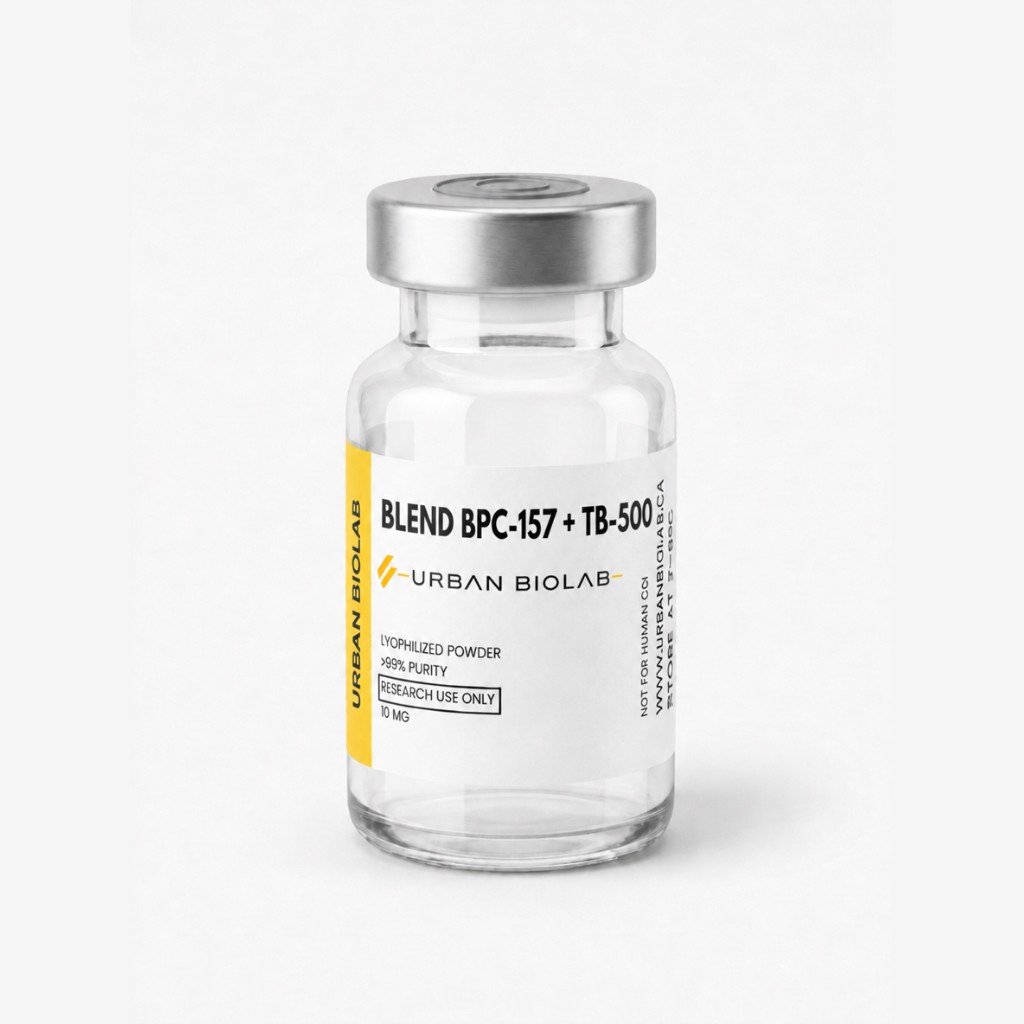
BPC-157 + TB-500 Blend 20MG
$149.95BPC-157 + TB-500 is a combined research peptide blend featuring two widely studied compounds known for their roles in tissue repair, cellular regeneration, and recovery-related signaling pathways. In laboratory research settings, this combination is of interest for investigations into connective tissue models, cell migration, angiogenesis, and regenerative biology, offering a complementary approach to studying complex repair mechanisms.
The “Bricks” Stack: You Can’t Build Without Materials
Peptides are signaling molecules—the blueprints. But you cannot synthesize new tendon tissue out of thin air. You need raw materials. Consider these supplements essential:
- Hydrolyzed Collagen: 20g daily. Provides the primary amino acids (Glycine and Proline) that make up tendon tissue.
- Vitamin C: 1000mg daily. A critical cofactor; without it, your body physically cannot cross-link collagen fibers.
- Copper Bisglycinate: 2mg daily. Required for Lysyl Oxidase, the enzyme that gives connective tissue its tensile strength.
Pro Tip: Take your Collagen and Vitamin C roughly 60 minutes before your rehab exercises to maximize amino acid uptake in the stimulated tissue.
Cycle Killers: What to Avoid
You are injecting a signal to “BUILD.” Avoid these common mistakes that send a signal to “DESTROY.”
- NSAIDs (Ibuprofen, Naproxen, Advil): This is the biggest mistake. Healing requires an initial acute inflammatory phase—it signals stem cells where to go. NSAIDs block this signal. Do not take them during a peptide cycle.
- Alcohol: It inhibits mTOR (protein synthesis), increases cortisol (a catabolic hormone), and dehydrates tissues. Keep alcohol to zero or near zero during the protocol.
- Ice (Cryotherapy): Ice constricts blood vessels. BPC-157 works by growing them. Icing an injury while taking BPC-157 works against the peptide’s primary mechanism. Use heat to drive blood flow instead.
Injury-Specific Guidance
General advice is good, but specific advice is better. Here are tailored approaches for common injuries.
1. Rotator Cuff (Supraspinatus)
- BPC-157 Injection: SubQ into the lateral deltoid (side of the shoulder).
- The Rehab Modifier: Focus on isometrics. Press the back of your hand into a doorframe (external rotation) as hard as you can without moving. Hold for 45 seconds.
- Timeline: Shoulders are slow. Expect a 10-12 week recovery.
2. Elbows (Tennis/Golfer’s Elbow)
- BPC-157 Injection: Pinch the loose skin on the top of the forearm, roughly 1 inch away from the painful elbow bone.
- The Rehab Modifier: Use the “Tyler Twist” with a FlexBar or perform slow wrist rotations with a light hammer (5 seconds per turn).
3. Patellar Tendon (Jumper’s Knee)
- BPC-157 Injection: Inject into the “VMO” (teardrop muscle on the inside of the quad) or the fat pad directly above the kneecap.
- The Rehab Modifier: Perform “Spanish Squats”—lean back into a squat with a band behind your knees, holding the bottom position for 45 seconds.
4. Achilles Tendon
- BPC-157 Injection: Do not inject near the Achilles itself (risk of infection). Inject into the calf muscle fat higher up the leg.
- The Rehab Modifier: Do Heavy Slow Calf Raises—3 seconds up, hold for 2 seconds, 4 seconds down. The eccentric (lowering) phase is key for aligning collagen fibers.
Frequently Asked Questions
Q: Does BPC-157 cause cancer?
A: No evidence suggests it initiates cancer. However, as it promotes angiogenesis, if you have an existing active malignancy, it could theoretically support tumor growth. Avoid if you have active cancer.
Q: Will I fail a drug test?
A: Yes. Both peptides are banned by WADA/USADA as “Peptide Hormones, Growth Factors, and Related Substances.” Metabolites can be detected for weeks.
Q: Can I stack this with HGH or TRT?
A: Yes. Testosterone and HGH increase protein synthesis and IGF-1. The Wolverine Stack directs those resources to the injury site, creating a powerful synergistic effect.
Q: Can I use oral BPC-157 for a tendon injury?
A: Standard BPC-157 (Acetate salt) is destroyed by stomach acid. Oral is superior for gut issues (IBS/Crohn’s), but injection is superior for tendon repair.
Q: I feel a hard lump under the skin after injection. What is it?
A: A “SubQ Depot.” You likely injected into a dense fat layer or didn’t go deep enough. It is harmless. Massage it with a warm washcloth; it will absorb in 3-5 days.
Final Thoughts
The Wolverine Stack represents a paradigm shift in soft tissue repair. By combining the angiogenic power of BPC-157 with the cell-mobilizing effects of TB-500, it addresses the root cause of chronic injuries. However, it is not a shortcut. It is a powerful tool that requires discipline, patience, and a comprehensive rehabilitation plan.
As with any advanced therapy, it is crucial to consult with a qualified healthcare professional to determine if this protocol is right for your specific condition.
Disclaimer: This article is for educational and informational purposes only and does not constitute medical advice. It is not a substitute for professional medical consultation, diagnosis, or treatment. Always consult your physician or other qualified health provider with any questions you may have regarding a medical condition or treatment.