
BPC-157 and TB-500 are often marketed as a healing stack for tendons and ligaments. This neutral review separates the animal data from the human evidence and explains the regulatory status.
The nickname “Wolverine Stack” borrows from the Marvel character famous for regenerating from nearly any injury — an apt name for a combination of two peptides marketed heavily to athletes and fitness enthusiasts for soft-tissue recovery: BPC-157 and TB-500.
What is BPC-157?
BPC-157 is a synthetic peptide consisting of 15 amino acids, derived from a protein that occurs naturally in human gastric juice — hence “Body Protective Compound.” It was originally studied for healing gastrointestinal ulcers, and later animal research expanded into tendon, ligament, muscle, and bone repair.
Based on animal and cell-level studies, the mechanisms most often attributed to BPC-157 are:
- Angiogenesis — stimulating the growth of new blood vessels, thought to be driven in part by upregulation of vascular endothelial growth factor (VEGF). This forms the basis for the claim that BPC-157 can “feed blood into” poorly vascularized tissue like tendons and ligaments.
- Fibroblast activity — encouraging the migration and function of the cells responsible for laying down collagen.
- Growth hormone sensitivity — some cell-level research suggests BPC-157 may increase the density of growth hormone receptors on fibroblast surfaces, though this finding has not been validated in human trials.
What is TB-500?
TB-500 is a synthetic peptide fragment corresponding to a portion of thymosin beta-4 (TB4), a naturally occurring protein found in nearly all cells. Thymosin beta-4 binds to actin, a protein that forms structural filaments inside cells and drives cell movement.
The proposed mechanism: by keeping actin in a “ready” state, TB-500 is thought to accelerate cell migration. Sources commonly cite figures of three to four times normal migration speed — these claims trace back to basic-science work on isolated cells, not human clinical trials. Unlike BPC-157, which is described as acting more locally, TB-500 is understood to act systemically throughout the body.
Why are they paired?
The stacking rationale rests on a division of labor:
- BPC-157 is described as building the infrastructure — establishing blood supply to tissue that normally heals slowly because it is poorly vascularized.
- TB-500 is described as bringing the workforce — mobilizing repair cells to the injury site.
Proponents describe the combination as complementary: one peptide opens the supply lines, the other delivers the laborers. What is rarely stated is that this synergy is a hypothesis built from separate lines of animal research — the combination itself has not been studied as a unit in any published human trial.
What the evidence shows
Animal and in-vitro evidence: substantial but preliminary
The research base for BPC-157 is real, and it is almost entirely preclinical. Reviews of the literature note that animal model studies have shown improved tendon healing, enhanced tendon-to-bone integration, and better muscle regeneration outcomes, with effects attributed to growth-factor stimulation and reduced inflammation. (McGuire et al., 2025 — Current Reviews in Musculoskeletal Medicine) (Emerging Use of BPC-157 in Orthopaedic Sports Medicine, 2025)
This body of work is why the peptide attracts genuine scientific interest. But animal results do not automatically translate to human safety, effective dosing, or clinical outcomes.
Human evidence:
This is the critical gap:
- No published, peer-reviewed randomized controlled trial has demonstrated that BPC-157 is effective or safe for musculoskeletal injury in humans.
- A 2025 narrative review in Current Reviews in Musculoskeletal Medicine concluded: “Until well-designed human trials are conducted and published, BPC-157 should not be recommended for clinical use in musculoskeletal medicine.” (Source)
- A second 2025 orthopaedic review stated plainly that “the in-human safety of BPC-157 was not assessed in the included studies and thus remains unknown.” (Source)
- One Phase I safety and pharmacokinetics trial in healthy volunteers is registered on ClinicalTrials.gov (NCT02637284) — but a Phase I safety study is not evidence of efficacy. (Source)
- For TB-500, scholarly literature searches located no human clinical trials at all. The marketed claims trace back to in-vitro and animal work, not human outcome data.
Sources themselves typically note that their detailed dosing protocols are derived from “aggregated clinical data” and “anecdotal logs,” and many present their protocols with disclaimers describing them as hypothetical and educational in nature. That is consistent with what the published record supports.
The honest way to frame this: an absence of evidence is not proof of harm — but it is equally not proof of benefit. The gap between the marketing confidence and the published record is wide.
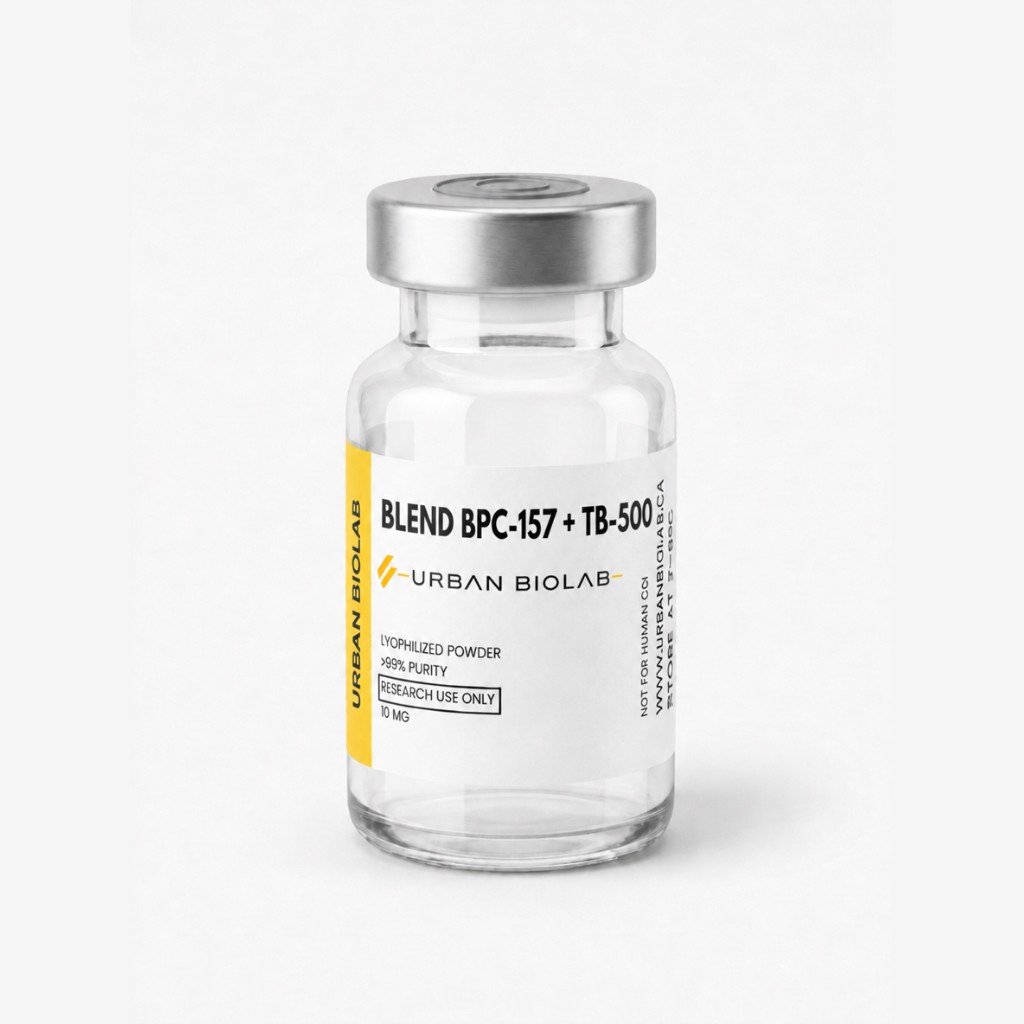
BPC-157 + TB-500 Blend 20MG
BPC-157 + TB-500 is a combined research peptide blend featuring two widely studied compounds known for their roles in tissue repair, cellular regeneration, and recovery-related signaling pathways. In laboratory research settings, this combination is of interest for investigations into connective tissue models, cell migration, angiogenesis, and regenerative biology, offering a complementary approach to studying complex repair mechanisms.
Risks and unknowns
Several risks deserve emphasis precisely because the compounds are widely available online:
- No approved medical status: Neither peptide is approved by the FDA (or equivalent regulators) for any human therapeutic use.
- Unregulated product quality: Products sold as “research chemicals” are not subject to pharmaceutical manufacturing oversight. Purity, sterility, and accurate labeling cannot be assumed — a meaningful safety concern for anything injected.
- Immunogenicity concerns: The FDA has flagged that compounded products containing BPC-157 may pose immunogenicity risks for certain routes of administration. (FDA: Bulk Drug Substances — Significant Safety Risks)
- No long-term safety data: With no approved use and no monitoring system, long-term adverse effects in humans are simply uncharacterized.
Regulatory and legal status
The legal picture is restrictive and worth understanding before considering these compounds:
- FDA: Neither BPC-157 nor TB-500 is approved for medical use in humans. (FDA Compounding Status Overview)
- Compounding pharmacies: Both peptides were previously placed on the FDA’s Category 2 bulk-substance list, indicating substances whose use in compounding may present significant safety risks. As of April 2026, both were removed from that list after their nominations were withdrawn — a procedural change, not an approval for human use. (FDA)
- Anti-doping (WADA): TB-500 — and thymosin beta-4 and its derivatives generally — is prohibited at all times under the WADA Prohibited List, Section S2 (Peptide Hormones, Growth Factors, Related Substances). Athletes using it will fail doping tests. (WADA Prohibited List)
- BPC-157: Not currently on the WADA list, but USADA explicitly warns athletes that it is unapproved, may have negative health effects, and could be added to the Prohibited List at any time. (USADA)
FAQ
Is the Wolverine Stack legal? Neither peptide is approved as a medicine. Sale as “research compounds” occupies a gray zone that varies by jurisdiction, and compounding is subject to FDA restrictions. Legal possession does not equal approved medical use.
Will I fail a drug test? If you use TB-500, yes. It is prohibited at all times under WADA rules, and most mainstream anti-doping panels follow the WADA standard.
Does the stack actually heal tendon injuries? The animal data is promising, but no human trials have confirmed safety or effectiveness. The 2025 review literature explicitly recommends against clinical use until such trials exist.
Why are online protocols so detailed if there’s no human evidence? Detailed protocols found online are typically extrapolated from animal studies and anecdotal reports, and the materials presenting them frequently describe the protocols as hypothetical and educational themselves. No validated human dosing exists.
Is it safe? Unknown. Human safety data is essentially nonexistent, and there are additional concerns around immunogenicity and the purity of unregulated products.
The bottom line
The Wolverine Stack is a combination whose components rest on a substantial animal-research foundation. TB-500 is banned for athletes under WADA rules, both peptides are unapproved by the FDA. For anyone considering these compounds for a real injury — tendon, ligament, or post-surgical recovery — the appropriate first step is a consultation with a sports-medicine physician or orthopedic surgeon.
Medical disclaimer: This article is for educational and informational purposes only. It is not medical advice, diagnosis, or treatment, and it does not endorse the use of any research compound. Neither BPC-157 nor TB-500 is an approved medicine. Always consult a qualified healthcare professional about any injury or health concern.