Educational and research disclaimer: This article is for educational and research discussion only. CJC-1295 and Ipamorelin are research peptides, are not approved for human use in many jurisdictions, and carry legal, safety, and contamination risks. The dosing and timeline details below are summarized from the source article’s reported protocols and anecdotal reports. They are not medical advice. Talk to a qualified clinician before considering any peptide protocol.
Why this stack gets so much attention
CJC-1295 (No DAC) plus Ipamorelin is one of the most discussed growth-hormone secretagogue combinations in peptide research communities. The appeal is simple: instead of injecting synthetic growth hormone, these peptides signal the pituitary to release more of the body’s own GH in pulses. The source article argues that this preserves natural feedback mechanisms and avoids the suppression of endogenous GH production that can occur with exogenous HGH.
The article also notes that most available content is either clinic marketing or fragmented forum anecdotes. Its goal is to provide a week-by-week picture of what users reportedly experience.
Individual variation matters. The timeline below is an average of reported experiences. Age, baseline GH, sleep, training, diet, and health status all affect outcomes. Some people notice changes in days; others take weeks.
The science in plain terms
The body regulates GH through at least two pathways:
- GHRH pathway: hypothalamic growth-hormone-releasing hormone tells the pituitary to increase GH output. CJC-1295 is a stabilized GHRH analog.
- GHRP/ghrelin pathway: growth-hormone-releasing peptides bind ghrelin receptors on the pituitary, trigger release of stored GH, and suppress somatostatin, the brake on GH secretion. Ipamorelin is a selective GHRP.
CJC-1295 (No DAC)
Natural GHRH degrades quickly. CJC-1295 has four amino-acid substitutions that make it more resistant to enzymatic breakdown. The No-DAC version—also called Modified GRF 1-29—has a short half-life of roughly 30 minutes and produces sharper GH pulses. The DAC version binds albumin and creates sustained GH elevation over about a week. Most protocols discussed in the source favor No-DAC because it better mimics natural pulsatile release.
Ipamorelin
Ipamorelin binds the ghrelin receptor (GHS-R1a), triggers GH release, and suppresses somatostatin. Its main selling point is selectivity: unlike older GHRPs such as GHRP-6 and GHRP-2, it is reported not to cause significant cortisol or prolactin spikes, and it does not trigger the intense hunger associated with GHRP-6.
Why they are paired
The source claims the combination produces roughly five times greater GH output than either peptide alone, because they act on different receptors and complementary mechanisms. CJC-1295 increases the number of somatotrope cells releasing GH; Ipamorelin triggers those cells to release stored hormone and removes the somatostatin brake.
| Feature | CJC-1295 (No DAC) | Ipamorelin |
|---|---|---|
| Receptor | GHRH receptor | Ghrelin receptor (GHS-R1a) |
| Main action | Increases somatotrope activity | Triggers GH release; suppresses somatostatin |
| GH pattern | Amplifies natural pulses | Initiates release pulses |
| Cortisol impact | None reported | None reported (unlike GHRP-2/6) |
| Appetite effect | None reported | None reported (unlike GHRP-6) |
| Half-life | ~30 minutes | ~2 hours |
Week-by-week reported timeline
Weeks 1–2: sleep changes first
The earliest reported changes are usually sleep-related. GH secretion peaks during slow-wave sleep, and the stack is claimed to create a positive feedback loop: better GH signaling → deeper sleep → more GH release.
Common reported experiences:
- More vivid and memorable dreams, often dramatically so.
- Improved morning alertness before total sleep time changes.
- Mild water retention—roughly 2–4 pounds—as GH affects fluid balance.
- Occasional injection-site redness that resolves quickly.
What usually does not happen yet:
- Visible body-composition change. Fat loss and muscle improvement require weeks of sustained GH elevation.
- Dramatic daytime energy improvements. Early changes may be subtle.
Practical focus: keep injection timing consistent, avoid food for 2–3 hours before administration, and keep a simple log of sleep and morning energy.
Weeks 3–4: energy and recovery improve
This is when functional changes become more noticeable.
Reported experiences:
- Faster recovery from exercise. DOMS may be less severe and shorter. Workouts that previously required 48–72 hours may allow productive training again in 24–36 hours.
- More stable energy through the day. The mid-afternoon crash becomes less pronounced.
- Reduced brain fog and improved focus.
- Water retention typically normalizes.
- Nagging joint stiffness may begin resolving.
The source attributes this to GH’s role in tissue repair, IGF-1 release from the liver, and improved metabolic efficiency—especially greater reliance on fatty-acid oxidation rather than glucose spikes and crashes.
Practical focus: if recovery supports it, increase training intensity carefully and track objective performance.
Weeks 5–6: the turning point
Around weeks five and six, accumulated benefits start becoming externally visible.
Reported experiences:
- Skin quality changes: fine lines may soften, skin feels firmer, elasticity improves. This aligns with collagen turnover, which takes roughly 4–6 weeks.
- Early body-composition shifts: clothes fit differently before the scale moves much. Waistbands loosen; arms and shoulders look slightly more defined.
- Fat redistribution rather than massive fat loss: GH preferentially mobilizes visceral fat, so the midsection may lean out before subcutaneous fat drops substantially.
- Sleep continues to improve; some users need slightly less sleep while feeling more rested.
The source describes this as a compounding phase: each night of better sleep and each improved workout adds up.
Weeks 7–8: visible body-composition change
This is when most users reportedly see undeniable physical changes.
Reported experiences:
- Fat loss accelerates, especially in stubborn areas such as lower abdomen, flanks, and lower back.
- Muscle definition improves; existing muscle appears fuller and harder.
- Strength on compound lifts may improve by roughly 5–15% compared with baseline.
- Muscular endurance improves.
- Libido and sexual function often improve.
- Friends or colleagues may comment on appearance.
The source claims that users combining the protocol with structured training and reasonable nutrition often lose 4–8 pounds of fat over weeks 1–8 while maintaining or slightly increasing lean mass. Those who change nothing else may still see modest fat reduction.
Practical focus: take progress photos, consider body-composition testing such as DEXA, and optimize nutrition to support continued progress.
Weeks 9–12: full benefits realized
The final month is described as the culmination of accumulated adaptations.
Reported experiences:
- Fat loss continues but may moderate as the body approaches a new equilibrium. Total fat reduction over 12 weeks is often reported as 6–12 pounds with reasonable nutrition; some report more with a structured caloric deficit.
- Lean mass is preserved during fat loss, which the source distinguishes from conventional dieting.
- Muscle maturation reaches full expression: denser, harder tissue and better definition.
- Energy and cognitive performance become the new normal.
- Anti-aging effects integrate: skin, joints, flexibility, and recovery from physical and mental stress all improve.
- Users in their forties, fifties, and beyond often describe feeling a decade or more younger.
| Area | Reported changes |
|---|---|
| Physical | 6–12 lbs fat loss with good nutrition; preserved or increased lean mass; improved definition; better skin, hair, and nail growth |
| Performance | 5–15% strength improvement; faster recovery; better endurance; more consistent training; fewer injuries |
| Wellbeing | Deeper sleep; stable all-day energy; better mental clarity; improved stress resilience and mood |
Beyond 12 weeks: months 3–6
Many users extend beyond 12 weeks. The source says benefits continue but the rate of visible change slows as you approach your optimized baseline.
- Body composition continues improving at a moderate pace. Users with significant fat to lose may still see meaningful reductions; those at target enter maintenance.
- Anti-aging benefits become more apparent with extended use because collagen remodeling and connective-tissue repair continue over months.
- Most protocols recommend cycling off after 12–16 weeks to avoid receptor desensitization. A common pattern is 12 weeks on, 4–8 weeks off, then repeat. Some prefer 16–20 weeks on with proportionally longer breaks.
- During off periods, your pituitary continues functioning normally. Physical improvements largely persist if sleep, training, and nutrition remain consistent. Energy and recovery may regress somewhat, and anti-aging effects fade gradually.
Long-term users reportedly describe a “quality of aging” benefit—maintaining physical and cognitive function that peers lose. This is anecdotal, not controlled evidence.
Dosing and administration as reported
The source describes a standard protocol of both peptides once daily in the evening before bed, aligning with natural GH release during early sleep.
| Peptide | Starting dose | Standard dose | Frequency |
|---|---|---|---|
| CJC-1295 (No DAC) | 0.1 mg | 0.1–0.2 mg | Once daily, evening |
| Ipamorelin | 0.1 mg | 0.2–0.3 mg | Once daily, evening |
Some protocols use twice- or three-times-daily dosing to create multiple GH pulses. The source says this can increase total GH output but adds complexity and may not produce proportionally better results for most users.
Administration notes from the source:
- Subcutaneous injection with insulin syringes.
- Common sites: lower abdomen at least two inches from the navel, front or side of thigh, back of upper arm. Rotate sites.
- Reconstitute with bacteriostatic water—typically 2 mL per vial, though vial size may require adjustment.
- Reconstituted peptides must be refrigerated at 2–8°C, never frozen, and protected from light. The source says they remain stable for roughly 4–6 weeks.
- Avoid food for 2–3 hours before injection and wait at least 30 minutes after injection before eating, because elevated insulin blunts GH release.
Stacking with other peptides
The source presents CJC-1295 + Ipamorelin as a foundation that can be complemented depending on goals.
| Goal | Base stack | Additions |
|---|---|---|
| General optimization | CJC-1295 + Ipamorelin | None needed |
| Injury recovery | CJC-1295 + Ipamorelin | BPC-157 0.25–0.5 mg daily |
| Comprehensive healing | CJC-1295 + Ipamorelin | BPC-157 + TB-500 |
| Anti-aging focus | CJC-1295 + Ipamorelin | GHK-Cu + BPC-157 |
The source advises against adding other GHRPs such as GHRP-2 or GHRP-6 to a stack already containing Ipamorelin, because they work through similar mechanisms and create redundancy rather than synergy. It also says additional GHRH compounds beyond CJC-1295 offer minimal benefit because they compete for the same receptors.
What happens when you stop
- First 1–2 weeks: Minimal change. GH levels return toward baseline gradually; improvements remain largely intact. Sleep may decrease slightly, and vivid dreams typically diminish.
- Weeks 2–4: Energy and recovery speed show the most noticeable regression. Fat-loss momentum stops; maintaining body composition requires more attention to diet and training.
- Long term: Physical improvements in body composition largely persist if lifestyle remains consistent. Muscle stays with continued training; fat stays off with appropriate nutrition. Anti-aging benefits fade more gradually over weeks to months.
- Pituitary function: The source says the secretagogue approach does not suppress natural GH production the way exogenous HGH can. No post-cycle therapy is described as necessary.
- Cycling: Periodic breaks are recommended to preserve receptor sensitivity and maintain effectiveness of subsequent cycles.
FAQ highlights
- How quickly do results appear? Sleep changes often in 1–2 weeks; energy and recovery in 3–4 weeks; visible body-composition changes around 6–8 weeks. Individual variation is significant.
- DAC vs. No DAC? DAC binds albumin and creates sustained GH elevation over about a week. No DAC produces shorter, sharper pulses and more closely mimics natural release; most protocols favor No DAC.
- Take together or separately? The source says take them together or immediately sequentially to preserve the synergistic effect.
- Can I eat around injection? Avoid food for 2–3 hours before and wait at least 30 minutes after, because insulin blunts GH release.
- Cycle length? Standard is 12–16 weeks on, 4–8 weeks off. Some prefer shorter or longer cycles.
- Will I lose gains after stopping? Body-composition improvements largely persist with consistent lifestyle. Energy and recovery may regress; anti-aging effects fade gradually.
- Why Ipamorelin over GHRP-2/6? Better selectivity: no significant cortisol or prolactin spike, and no intense hunger.
- Can women use it? The source says yes, at the same doses, with reported improvements in skin, sleep, and body composition.
- Storage? Refrigerate reconstituted peptides at 2–8°C, never freeze, protect from light; stable for roughly 4–6 weeks.
- Side effects? Common reported effects include mild water retention in the first 1–2 weeks, occasional injection-site redness, and vivid dreams. Less common: headaches, facial flushing, lightheadedness. Serious effects are described as rare.
- Stack with BPC-157? Yes, the source says they complement each other for recovery and healing.
- Compared with HGH injections? The peptide approach stimulates endogenous GH, preserves feedback mechanisms, costs less, and avoids suppression of natural production. The source estimates 10–20% of HGH pricing.
- Post-cycle therapy? Not required, according to the source, because the stack works with endogenous signaling rather than replacing it.
- Age to consider? GH declines around age 30 by roughly 15% per decade. Most users reportedly start in their late thirties to early forties.
- Drug tests? Both are prohibited by WADA and USADA and can be detected through specialized testing. Standard employment or medical screenings do not typically test for them.
Glossary
- Anterior pituitary: Front part of the pituitary gland; contains somatotrope cells that produce and release GH.
- Bacteriostatic water: Sterile water with 0.9% benzyl alcohol; used to reconstitute peptides and inhibit bacterial growth.
- DAC (Drug Affinity Complex): Modification that lets CJC-1295 bind albumin, extending half-life to about a week.
- Ghrelin receptor (GHS-R1a): Receptor that binds ghrelin and is activated by GHRPs such as Ipamorelin.
- GHRH: Growth-hormone-releasing hormone; hypothalamic signal for GH production. CJC-1295 is a stabilized analog.
- GHRP: Growth-hormone-releasing peptide class; activates ghrelin receptors. Examples: Ipamorelin, GHRP-2, GHRP-6, Hexarelin.
- Half-life: Time for half a substance to be eliminated. CJC-1295 No DAC ~30 minutes; Ipamorelin ~2 hours.
- IGF-1: Insulin-like growth factor 1; produced in the liver in response to GH; mediates many anabolic effects.
- Lipolysis: Breakdown of stored fat into free fatty acids and glycerol for energy; promoted by GH.
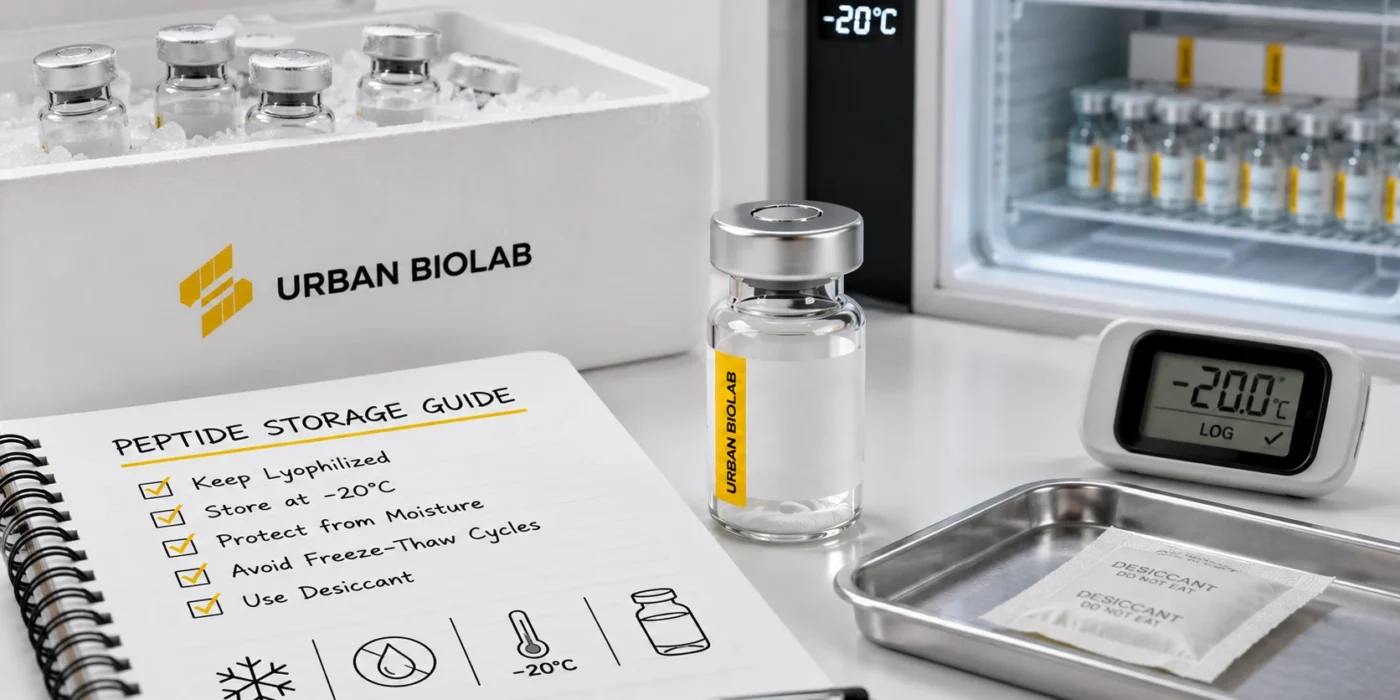
- Lyophilized: Freeze-dried powder form of peptides before reconstitution.
- Modified GRF 1-29: Another name for CJC-1295 without DAC.
- Pulsatile release: Natural pattern of GH secretion in discrete pulses rather than continuous elevation.
- Secretagogue: Substance that stimulates secretion of another substance; both CJC-1295 and Ipamorelin are GH secretagogues.
- Slow-wave sleep: Deep non-REM sleep when most natural GH is released.
- Somatostatin: Hormone that inhibits GH release; Ipamorelin suppresses it.
- Somatotrope: Pituitary cells that produce and store GH.
- Subcutaneous injection: Into the fat layer beneath the skin.
- Synergy: Combined effect greater than the sum of individual effects.
- Visceral fat: Fat around internal organs; preferentially targeted by GH’s lipolytic effects.
Bottom line
The source presents CJC-1295 + Ipamorelin as a GH-secretagogue stack with a predictable reported sequence: sleep first, then energy and recovery, then skin and early body-composition shifts, then visible fat loss and muscle definition by weeks 7–12. It emphasizes cycling, evening dosing on an empty stomach, proper refrigeration, and realistic expectations. The evidence base is a mix of small clinical studies, mechanistic research, and aggregated anecdotal reports—not large, long-term human trials of the combination. Anyone considering it should weigh legal status, safety, and the lack of regulatory oversight against the reported benefits.