Quick answer: BPC-157 and TB-500 are two peptides often discussed together for tissue repair and recovery. When combined—sometimes called the “Wolverine Stack”—they are said to work through complementary pathways: BPC-157 focuses on local repair of tendons, ligaments, and the gut, while TB-500 is described as providing systemic regeneration throughout the body. Combined protocols are reported to produce roughly 30–60% faster recovery, based on user reports and preliminary research. Neither peptide is approved by Health Canada or the FDA for human therapeutic use, and quality varies widely between suppliers.
A Real-World Report
The guide includes an account from Brandon Thomson, a construction worker near Edmonton. He says he suffered a partial rotator cuff tear lifting rebar overhead. His doctor recommended anti-inflammatories and told him it would be at least six months before returning to full duty.
A friend encouraged him to look into peptides. He started BPC-157 at 0.25 mg daily injected near the shoulder, plus TB-500 at 2.5 mg twice weekly. Within about a week and a half, the constant ache that woke him at night began to fade. By week four, he had full range of motion with only minor discomfort. By eight weeks, he was back on the job. His physiotherapist was reportedly surprised by how quickly inflammation dropped and mobility returned.
Protocol used:
- BPC-157: 0.25 mg daily, subcutaneous near injury
- TB-500: 2.5 mg twice weekly, subcutaneous abdominal
- Duration: 8 weeks
What Are BPC-157 and TB-500?
BPC-157 stands for Body Protection Compound 157. It is a synthetic 15-amino-acid peptide derived from a protein found in human gastric juice. It does not occur naturally in its exact form. Its gastric origin is one reason it is often discussed for gastrointestinal healing as well as musculoskeletal repair. It is unusually stable in stomach acid—reportedly for over 24 hours—which makes oral use possible for gut-related applications.
TB-500 is a synthetic 43-amino-acid fragment of Thymosin Beta 4, a protein present in nearly every human and animal cell. Thymosin Beta 4 plays roles in wound healing, cell migration, and tissue regeneration. TB-500 replicates the active portion of that protein. Its molecular weight is about 4,963 daltons, allowing it to distribute systemically through the bloodstream. BPC-157 is smaller and tends to concentrate more at injection sites, though it also has some systemic effects.
Neither peptide has received approval from Health Canada or the FDA for human therapeutic use. They exist in a regulatory gray area—often sold for research purposes—so quality control varies dramatically. Preclinical evidence and anecdotal reports are extensive, but human clinical trials remain limited.
How They Work
BPC-157 Mechanisms
BPC-157 is described as acting through several pathways:
- FAK-paxillin pathway: enhances migration of fibroblasts, the cells that repair connective tissue.
- Growth hormone receptor upregulation: increases receptor density on tendon fibroblasts, making tendons more responsive to natural healing signals.
- VEGFR2-Akt-eNOS pathway: promotes angiogenesis—new blood vessel formation. Research has documented 129–152% increases in angiogenesis in treated tissues.
- Nitric oxide modulation: helps normalize inflammation.
- Erg-1 transcription factor inhibition: allows the body to move from inflammation to rebuilding more efficiently.
TB-500 Mechanisms
TB-500 works differently:
- Actin binding: binds to G-actin, preventing premature polymerization into rigid filaments. This enhances cell mobility and chemotaxis, helping repair cells reach damaged tissue.
- VEGF upregulation via HIF-1alpha: promotes angiogenesis through a different pathway than BPC-157.
- Inflammation modulation: increases microRNA-146a while decreasing pro-inflammatory cytokines including TNF-alpha, IL-6, IRAK1, and TRAF6—without fully suppressing immune function like corticosteroids can.
- Collagen production and alignment: promotes proper fiber alignment, which helps restore functional tissue rather than weak scar tissue.
Why They Are Combined
The proposed synergy occurs at multiple levels:
- BPC-157 increases actin gene expression; TB-500 organizes the resulting actin for cell movement.
- BPC-157 upregulates growth hormone receptors; TB-500 enhances the cellular machinery that uses them.
- Both promote angiogenesis through different pathways, creating redundancy and amplification.
- Their anti-inflammatory mechanisms complement each other.
Research reportedly shows about 30% faster healing with the combination versus either peptide alone, with enhanced fibroblast activity and immune cell migration. User reports often describe closer to 60% better outcomes with the stack.
BPC-157: Tendon and Gut Specialist
BPC-157 has been studied extensively in animals. Human trials remain limited, but user reports are widespread.
Musculoskeletal applications:
- Tendon injuries: tennis elbow, Achilles tendinopathy, rotator cuff issues, patellar tendinopathy. Typical protocol: 0.25–0.5 mg daily subcutaneously near the injured tendon for 4–8 weeks. Many users report pain reduction and mobility improvements within the first week.
- Ligament injuries: heal more slowly due to poor blood supply. Rat studies on MCL transection showed restored biomechanical properties. Typical protocol: 0.25–0.5 mg daily for 6–8 weeks, often combined with TB-500 at 2–5 mg weekly.
- Muscle injuries: 0.25–0.5 mg daily for 2–4 weeks post-injury.
Gastrointestinal healing: This is BPC-157’s original research focus. It is said to repair intestinal mucosal damage, restore tight junction integrity, normalize gastric emptying and motility, protect against NSAID-induced ulcers, and promote healing of IBD lesions. For IBS, IBD, gastritis, or ulcers, oral administration at 0.5–1 mg daily is typical. The arginine salt form is reported to have high oral bioavailability—only 15.1% degradation after five hours at pH 3.0, versus 99% destruction of standard acetate forms. Improvements in bloating, discomfort, and bowel regularity are often reported within 1–2 weeks, with full benefit over 4–6 weeks.
Neuroprotection: Preclinical research shows promise in traumatic brain injury, stroke, spinal cord injury, and peripheral nerve damage models. Mechanisms include reduced excitotoxicity and oxidative stress, enhanced neurotrophic factor expression, improved cerebral blood flow, and modulation of dopamine and serotonin. Protocols use 0.25–0.5 mg daily subcutaneously or orally. These remain early-stage findings.
TB-500: Systemic Regeneration
TB-500’s key advantage is whole-body distribution. It reaches virtually every tissue, making it useful for multiple concurrent injuries or general recovery.
Muscle and athletic applications: TB-500 is particularly associated with muscle healing and flexibility. Mouse studies on skeletal muscle injuries showed improved fiber regeneration in dystrophin-deficient mice over six months. Community reports describe athletes with severe hamstring tears returning to deadlift personal records in five to six weeks—a timeline that would normally take three to four months. Rotator cuff and shoulder injuries generate especially enthusiastic reports, with recovery in four to eight weeks.
Human clinical evidence: More human data exists for TB-500 than for BPC-157. A 2010 randomized controlled trial involving 40 healthy adults received intravenous doses ranging from 42 to 1,260 mg of thymosin beta 4. The peptide was well tolerated with minimal toxicity risk; adverse events were mild to moderate. A 73-participant venous ulcer study showed 45% faster healing in treated groups compared to controls.
What TB-500 does not do well: It shows poor results for chronic, long-standing injuries with established dysfunction. It may improve chronic conditions to 70–90% of baseline rather than complete resolution. It is not considered effective for lower back pain or structural spinal issues. Failure stories often involve chronic injuries exceeding six months or structural spinal problems.
The Wolverine Stack: Combining Both
The combination is nicknamed the “Wolverine Stack” for its reported healing acceleration.
Why it works: BPC-157 provides targeted local repair and gut healing; TB-500 delivers systemic regeneration and cell migration enhancement. The complementary mechanisms address injuries from multiple angles.
Standard protocol:
| Phase | TB-500 | BPC-157 |
|---|---|---|
| Loading (weeks 1–4) | 2–2.5 mg twice weekly (Mon/Thu), totaling 4–5 mg/week | 0.5 mg daily, or 0.25 mg twice daily |
| Maintenance (weeks 5–8+) | 2 mg once weekly | 0.25–0.5 mg daily |
Critical notes:
- Use separate vials and syringes for each peptide.
- Never mix BPC-157 and TB-500 in the same syringe.
- TB-500 can be injected anywhere subcutaneously.
- BPC-157 should ideally be injected near the injury site.
Advanced variations: Adding MK-677 (Ibutamoren) at 10–25 mg before bed provides oral growth hormone stimulation, which may synergize with BPC-157’s growth hormone receptor upregulation. A “GLOW Blend” adds GHK-Cu to BPC-157 and TB-500 for tissue healing, inflammation, flexibility, collagen synthesis, and skin health. Typical GLOW dosing is 0.9–1.8 mg daily subcutaneously for 6–8 weeks, with a 90-day maximum and a 30-day washout.
Dosing Guidelines
BPC-157
| Application | Daily Dose | Duration | Notes |
|---|---|---|---|
| Conservative start | 0.2–0.25 mg | 4–6 weeks | Beginners or minor injuries |
| Standard | 0.25–0.5 mg | 4–8 weeks | Most common |
| Aggressive acute | 0.75–1 mg for 3 days, then 0.5 mg | 6–8 weeks | Severe acute injuries |
| Chronic conditions | 0.5 mg twice daily | 6–8 weeks minimum | Split dosing |
| Post-surgical | 0.5–0.75 mg split | 8–12 weeks with taper | Extended support |
Single daily dosing suits general recovery. Split dosing every 12 hours better matches the peptide’s 4–6 hour half-life.
TB-500
| Phase | Dose | Frequency | Duration |
|---|---|---|---|
| Loading (standard) | 2–2.5 mg | Twice weekly | 4–6 weeks |
| Loading (aggressive) | 2.5–3 mg | Twice weekly | 4 weeks |
| Maintenance | 2 mg | Once weekly | 2–6 weeks |
| Extended maintenance | 2 mg | Every 7–14 days | As needed |
Weight-based dosing is about 0.085 mg/kg/week. A 90 kg person would use roughly 7.66 mg weekly. This method lacks clinical validation.
Injection sites: abdomen (at least two inches from navel), front and outer thighs, back of upper arms. Rotate sites to prevent lipohypertrophy and scar tissue. For BPC-157 targeting a local injury, inject one to two inches from the injury—not directly into damaged tissue.
Reconstitution and Storage
Both peptides usually arrive as lyophilized powder and require reconstitution with bacteriostatic water (0.9% benzyl alcohol).
Steps:
- Let vials reach room temperature for 15–30 minutes.
- Disinfect rubber stoppers and let alcohol evaporate.
- Draw bacteriostatic water into a syringe.
- Angle the needle against the vial wall and inject slowly down the side—never squirt directly onto the powder.
- Gently swirl or roll the vial. Never shake vigorously.
- Let it dissolve for 10–20 minutes until clear.
- Inspect for cloudiness, discoloration, or particles.
Examples:
- 5 mg BPC-157 + 2.5 mL water = 2 mg/mL. 0.125 mL (12.5 units on an insulin syringe) = 0.25 mg.
- 5 mg TB-500 + 2 mL water = 2.5 mg/mL. 0.1 mL (10 units) = 0.25 mg; 1 mL = 2.5 mg.
Storage:
- Unreconstituted powder: refrigerator (2–8°C) for up to 24 months, or freezer for years.
- Reconstituted BPC-157: refrigerator only, use within 4 weeks.
- Reconstituted TB-500: refrigerator only, use within 7–14 days.
- Never freeze reconstituted solution.
- Write the reconstitution date on the vial.
- Discard if cloudy or discolored.
Common mistakes: injecting water directly onto powder, shaking vigorously, storing reconstituted peptide at room temperature, freezing reconstituted solution, and using sterile water instead of bacteriostatic water.
Timeline of Results
Acute injuries (less than two weeks old):
- Days 1–3: reduced inflammation and pain; sleep improves.
- Days 4–7: noticeable mobility improvement; swelling decreases.
- Weeks 2–4: 50–70% improvement from baseline.
- Weeks 4–8: near-complete or complete resolution for many soft tissue injuries.
Chronic injuries (six months or longer):
- Minimum 2–4 weeks before judging effectiveness; some need 6+ weeks.
- Longer cycles of 8–12 weeks, higher cumulative doses, and tempered expectations.
- May improve to 70–90% of baseline rather than complete resolution.
Signs peptides are working: improved sleep, reduced morning stiffness, better range of motion, less reliance on pain medication, ability to perform previously painful movements, reduced swelling.
Signs of quality issues: zero response after three weeks of consistent use strongly suggests a product quality problem rather than the peptide being ineffective.
Best Uses for Each Peptide
Choose BPC-157 for:
- Tendon injuries (tennis elbow, golfer’s elbow, Achilles, patellar, rotator cuff)
- Ligament damage (partial tears, sprains)
- Gastrointestinal problems (ulcers, IBD, IBS, gastritis, leaky gut)
- Protecting tissues from corticosteroid damage
- Nerve protection and neuroprotection
- Single localized injury
Choose TB-500 for:
- Muscle injuries (strains, tears, atrophy)
- Multiple concurrent injury sites
- Systemic inflammation
- Post-surgical recovery involving muscle
- Limited mobility and flexibility
- General athletic recovery
Choose both for:
- Severe injuries requiring maximum support
- Complex injuries involving multiple tissue types
- Post-surgical recovery from major procedures
- Chronic joint pain with local and systemic inflammation
- High-volume athletic training with accumulated stress
- Any situation where optimal recovery speed matters
Safety Considerations
Observed side effects:
- BPC-157: mild nausea (oral), temporary dizziness, minor injection site reactions, occasional headache. Usually resolve within days.
- TB-500: in the 40-person safety study, adverse events were mild to moderate. User reports mention flu-like symptoms during loading, temporary fatigue, head rush, and minor injection site reactions. The 1,260 mg maximum tested dose far exceeds typical protocols.
Theoretical concerns:
- Both peptides promote angiogenesis, which raises theoretical questions about cancer risk. However, BPC-157 has also been shown to suppress Ki-67 and downregulate VEGF in some tumor models, so the relationship is complex.
- Individuals with cancer history, active malignancy, or strong family history should consult an oncology professional before considering angiogenic compounds.
- Long-term safety data does not exist for either peptide in humans.
Contamination risks: Studies of ergogenic supplements find 12–58% contamination rates, 30% containing incorrect amino acid sequences, and 65% exceeding safe endotoxin thresholds. Counterfeit or impure products can contain bacterial endotoxins, wrong peptide sequences, heavy metals, and residual solvents.
Quality verification:
- Third-party Certificate of Analysis with HPLC-MS testing
- Purity greater than 98%, preferably 99%+
- Endotoxin testing below safe thresholds
- Clear documentation of peptide sequence and synthesis method
- Established vendor reputation
- Proper storage and shipping
Sourcing in Canada
Health Canada has increased enforcement against unauthorized peptide sales, with vendor shutdowns and product seizures. Peptides sold for human therapeutic use without approval violate federal regulations. Products marketed as research chemicals occupy a gray area with less clear enforcement but still face regulatory risk.
Canadian buyers may prefer domestic suppliers for faster shipping, no customs delays, CAD pricing, and familiarity with Canadian regulations. Quality markers include a Certificate of Analysis with HPLC-MS, purity above 98%, endotoxin testing, third-party lab results, and a reputable vendor. Red flags include no CoA, unclear sequence information, poor storage/shipping, no verifiable reputation, prices significantly below market, and poorly presented websites.
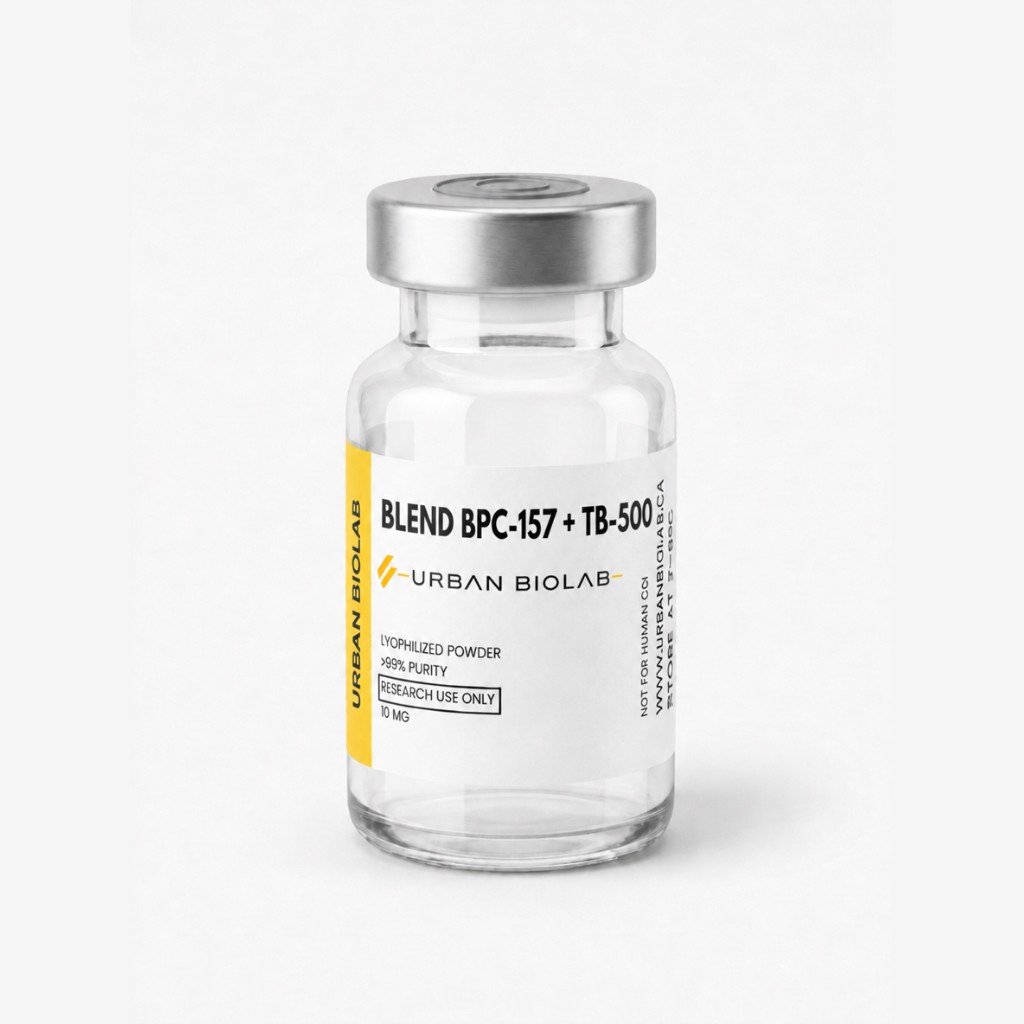
BPC-157 + TB-500 Blend 20MG
BPC-157 + TB-500 is a combined research peptide blend featuring two widely studied compounds known for their roles in tissue repair, cellular regeneration, and recovery-related signaling pathways. In laboratory research settings, this combination is of interest for investigations into connective tissue models, cell migration, angiogenesis, and regenerative biology, offering a complementary approach to studying complex repair mechanisms.
Frequently Asked Questions
Can I mix BPC-157 and TB-500 in the same syringe?
No. Peptides can lose effectiveness when mixed. Use separate vials and syringes.
How quickly will I see results?
Acute injuries often show improvement within 3–7 days, with substantial recovery by 2–4 weeks. Chronic injuries require 4–8 weeks minimum before judging effectiveness.
Should I inject near the injury?
For BPC-157, injecting 1–2 inches from the injury provides maximum local concentration. For TB-500, injection location matters less because it distributes systemically.
Are these peptides legal in Canada?
Neither has Health Canada approval for human therapeutic use. They exist in a regulatory gray area when sold as research chemicals. Enforcement has increased against vendors marketing them for human consumption.
Can I take BPC-157 orally?
Yes, particularly the arginine salt form. Oral use makes most sense for gastrointestinal applications. For musculoskeletal injuries, injection provides higher local tissue concentrations.
How long should I run a cycle?
Acute injuries: 4–6 weeks. Chronic conditions: 6–8 weeks minimum. Post-surgical: 8–12 weeks with tapering. Most users take 2–4 week breaks between cycles.
What if the peptides do not work for me?
Zero response after three weeks most commonly indicates product quality issues. Structural injuries like complete tears, disc herniations, and bone spurs show minimal response regardless of quality.
Can I use these with other medications?
No significant interactions are documented, but comprehensive studies have not been conducted. Inform healthcare providers and monitor for unexpected effects. Caution with blood thinners and immunosuppressants.
Is long-term use safe?
Long-term safety data does not exist. Conservative approaches suggest cycling with breaks rather than continuous use.
Do I need to refrigerate the peptides?
Unreconstituted powder can be refrigerated or frozen. Reconstituted peptides must remain refrigerated and used within 4 weeks (BPC-157) or 7–14 days (TB-500). Never freeze reconstituted solutions.
Will these show up on drug tests?
TB-500 appears on WADA prohibited lists and can be detected weeks after cessation. BPC-157 is not specifically listed but may be considered an unapproved substance. Competitive athletes should assume detection risk.
Can women use these peptides?
Yes. Neither has hormone-related mechanisms that would create sex-specific concerns. Pregnant or breastfeeding women should avoid them due to lack of safety data.
Glossary
- Angiogenesis: Formation of new blood vessels.
- Bacteriostatic water: Sterile water with 0.9% benzyl alcohol as a preservative.
- Chemotaxis: Directed cell movement toward chemical signals.
- Collagen: Primary structural protein in connective tissues.
- Cytokines: Small proteins that regulate immune and inflammatory responses.
- FAK-Paxillin Pathway: Cellular signaling system controlling fibroblast migration.
- Fibroblast: Cell type that produces connective tissue and collagen.
- G-Actin: Globular monomer form of actin protein.
- Half-Life: Time for half a substance to be eliminated.
- Lyophilized: Freeze-dried.
- Subcutaneous Injection: Injection into fatty tissue beneath the skin.
- Thymosin Beta 4: Naturally occurring protein involved in wound healing and regeneration.
- VEGF: Vascular Endothelial Growth Factor, promotes blood vessel formation.
- Wolverine Stack: Combination protocol using BPC-157 and TB-500 together.
Sources
- Gwyer D, Wragg NM, Wilson SL. Gastric pentadecapeptide body protection compound BPC 157 and its role in accelerating musculoskeletal soft tissue healing. Cell Tissue Res. 2019;377(2):153-159.
- Goldstein AL, Hannappel E, Sosne G, Kleinman HK. Thymosin beta4: a multi-functional regenerative peptide. Expert Opin Biol Ther. 2012;12(1):37-51.
- Sikiric P, Seiwerth S, Rucman R, et al. Stable gastric pentadecapeptide BPC 157: novel therapy in gastrointestinal tract. Curr Pharm Des. 2011;17(16):1612-1632.
This article is for informational purposes only and is not medical advice. Neither BPC-157 nor TB-500 is approved by Health Canada or the FDA for human therapeutic use. Consult a licensed healthcare professional before using any peptide.