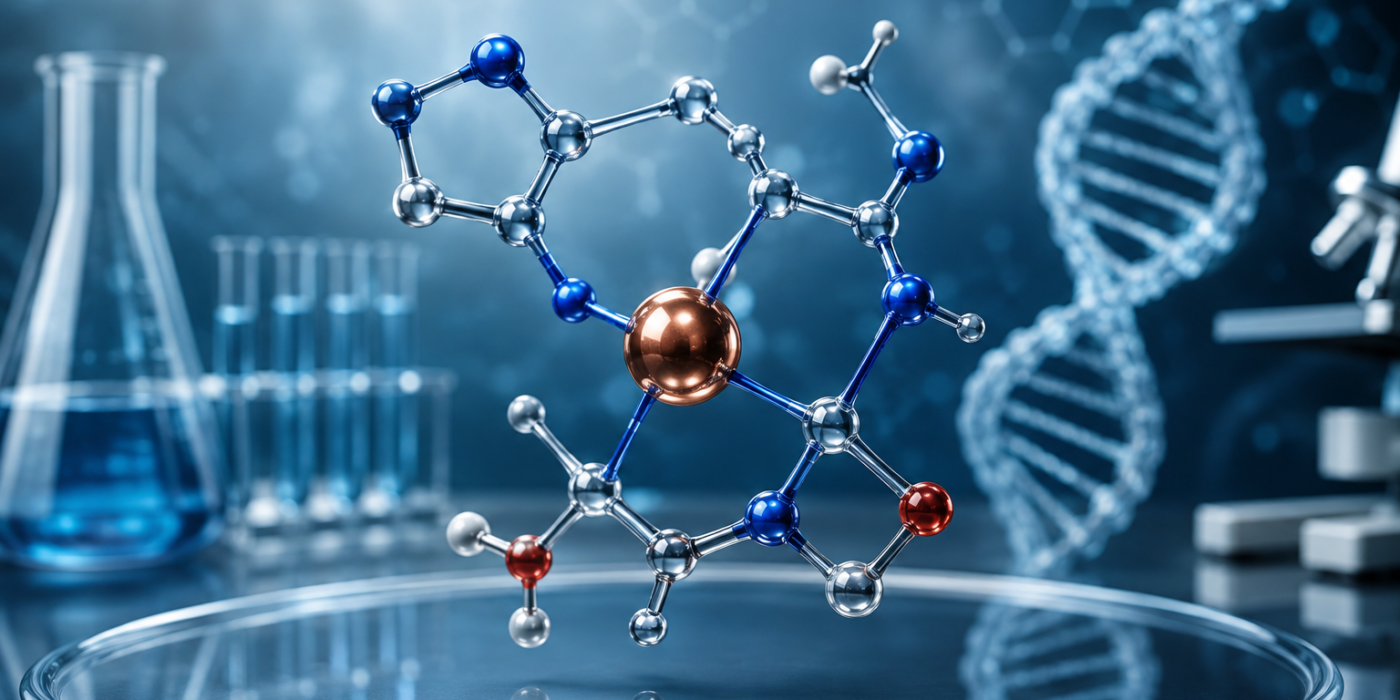
GHK-Cu is unusual even by peptide-research standards.
It consists of only three amino acids — glycine, histidine and lysine — bound to copper. Yet this small naturally occurring complex has been investigated for more than five decades across areas including extracellular-matrix biology, oxidative stress, inflammatory signalling, tissue repair and gene expression.
Today, GHK-Cu remains one of the better-known copper peptides in laboratory research.
But what does the evidence actually show? Why is the copper component important? And what should Canadian researchers understand when evaluating GHK-Cu as a research material?
This guide looks at the science behind GHK-Cu, the areas researchers are investigating, and the analytical standards that matter when evaluating research-grade material.
Research-use notice: This article discusses GHK-Cu in the context of scientific and laboratory research. It is provided for educational purposes only and is not medical advice.
What is GHK-Cu?
GHK-Cu is a copper-binding tripeptide complex.
The peptide itself is:
Glycyl-L-histidyl-L-lysine (GHK)
When GHK binds a divalent copper ion (Cu²⁺), it forms the complex commonly known as GHK-Cu.
GHK occurs naturally in the human body and was identified during research into components of human plasma in the 1970s.
Since then, researchers have investigated GHK and GHK-Cu across a surprisingly broad range of biological systems.
Much of the interest comes from an unusual combination of properties.
GHK can bind copper with high affinity, while research has also associated the peptide with changes in cellular signalling, extracellular-matrix activity and gene expression.
That makes GHK-Cu more interesting scientifically than simply describing it as a peptide containing copper.
Why does GHK bind copper?
Copper is an essential trace element involved in numerous biological processes.
Several enzymes require copper to function properly, including enzymes involved in connective-tissue formation, antioxidant defence and cellular energy metabolism.
But free copper ions can also be chemically reactive.
Biological systems therefore need mechanisms for transporting and controlling copper.
GHK’s ability to bind Cu²⁺ provides researchers with an interesting model for studying this relationship.
Rather than thinking of GHK-Cu as simply GHK + copper, it is more useful to think of the copper-peptide complex as its own research unit.
The interaction between the peptide and copper affects the chemistry and biological behaviour researchers are attempting to understand.
The three major areas of GHK-Cu research
The scientific literature surrounding GHK-Cu is extensive, but much of it can be grouped into three broad areas.
1. Extracellular-matrix remodelling
One of the oldest areas of GHK-Cu research concerns the extracellular matrix.
The extracellular matrix, or ECM, is the structural network surrounding cells. It includes proteins and other molecules such as collagen, elastin and glycosaminoglycans.
Research involving GHK-Cu has examined processes including:
- collagen synthesis;
- fibroblast activity;
- extracellular-matrix turnover;
- glycosaminoglycan production; and
- matrix metalloproteinase activity.
Interest in this area dates back decades.
Research published in the 1980s, for example, reported effects of glycyl-L-histidyl-L-lysine on collagen synthesis in fibroblast cultures.
Subsequent research expanded the investigation into broader questions concerning tissue remodelling and cellular repair.
2. Oxidative and inflammatory signalling
Another significant area of GHK-Cu research concerns oxidative stress.
Reactive oxygen species — usually abbreviated ROS — are produced naturally during cellular metabolism. Excessive oxidative activity, however, can damage cellular structures.
Researchers have investigated GHK-Cu in experimental systems involving antioxidant activity and the regulation of inflammatory signalling.
Published research has associated GHK with changes in pathways involving inflammatory cytokines, antioxidant defence and oxidative stress.
These findings don’t mean GHK-Cu should simply be labelled an “anti-inflammatory” or “antioxidant” treatment.
Rather, they identify biological pathways in which the compound continues to be studied.
3. Cellular repair and regenerative biology
GHK-Cu also appears frequently in research involving fibroblasts, keratinocytes and other cellular systems relevant to tissue repair.
Researchers have investigated effects involving cellular migration, extracellular-matrix production and signalling associated with repair processes.
This has made GHK-Cu a recurring compound in the broader field of regenerative-biology research.
GHK-Cu and gene expression
One of the most interesting — and sometimes overstated — areas of GHK research concerns gene expression.
Gene-expression analyses have reported broad changes in patterns of gene activity associated with exposure to GHK.
Research discussed by Pickart and colleagues identified changes involving genes connected with biological processes such as tissue repair, inflammatory signalling, antioxidant defence and cellular maintenance.
This is scientifically interesting because it suggests that GHK may influence multiple biological pathways rather than acting through one simple mechanism.
But these findings require careful interpretation.
Gene-expression results depend heavily on the experimental system, cell type, exposure conditions and analytical methodology.
Changes observed in a gene-expression database or laboratory model should therefore not automatically be interpreted as demonstrating a corresponding effect in humans.
The important research question is not whether GHK simply “switches genes on and off.”
It is whether the patterns identified in experimental systems can be independently reproduced and connected to meaningful biological effects.
That remains an active area of research.
Why GHK-Cu appears in aging research
Another reason GHK has attracted scientific interest is that it occurs naturally in human plasma and its concentration has been reported to decline with age.
That observation has led researchers to investigate possible relationships between GHK, aging biology and changes in regenerative processes.
Experimental work has consequently examined GHK-Cu in areas involving:
- oxidative stress;
- cellular maintenance;
- extracellular-matrix changes;
- inflammatory signalling; and
- age-associated changes in tissue biology.
This is an interesting research hypothesis, but an important distinction should be maintained:
An age-related decline in a naturally occurring molecule does not automatically mean replacing that molecule reverses aging.
That requires considerably stronger evidence.
For researchers, the decline is better viewed as a clue that may help explain why GHK participates in biological processes associated with cellular maintenance and repair.
GHK-Cu and collagen research
Collagen is probably the biological molecule most closely associated with GHK-Cu.
Fibroblasts are cells responsible for producing many components of the extracellular matrix, including collagen.
Laboratory research has reported changes in collagen-related activity following exposure to GHK and GHK-Cu.
This has led to continued investigation of the peptide in experimental models involving connective tissue and matrix remodelling.
However, collagen biology is complex.
Producing more collagen isn’t automatically beneficial in every biological context. Healthy tissue requires controlled synthesis, organisation and degradation of extracellular-matrix components.
For that reason, matrix remodelling is generally a more scientifically useful description of the research than simply saying GHK-Cu “increases collagen.”
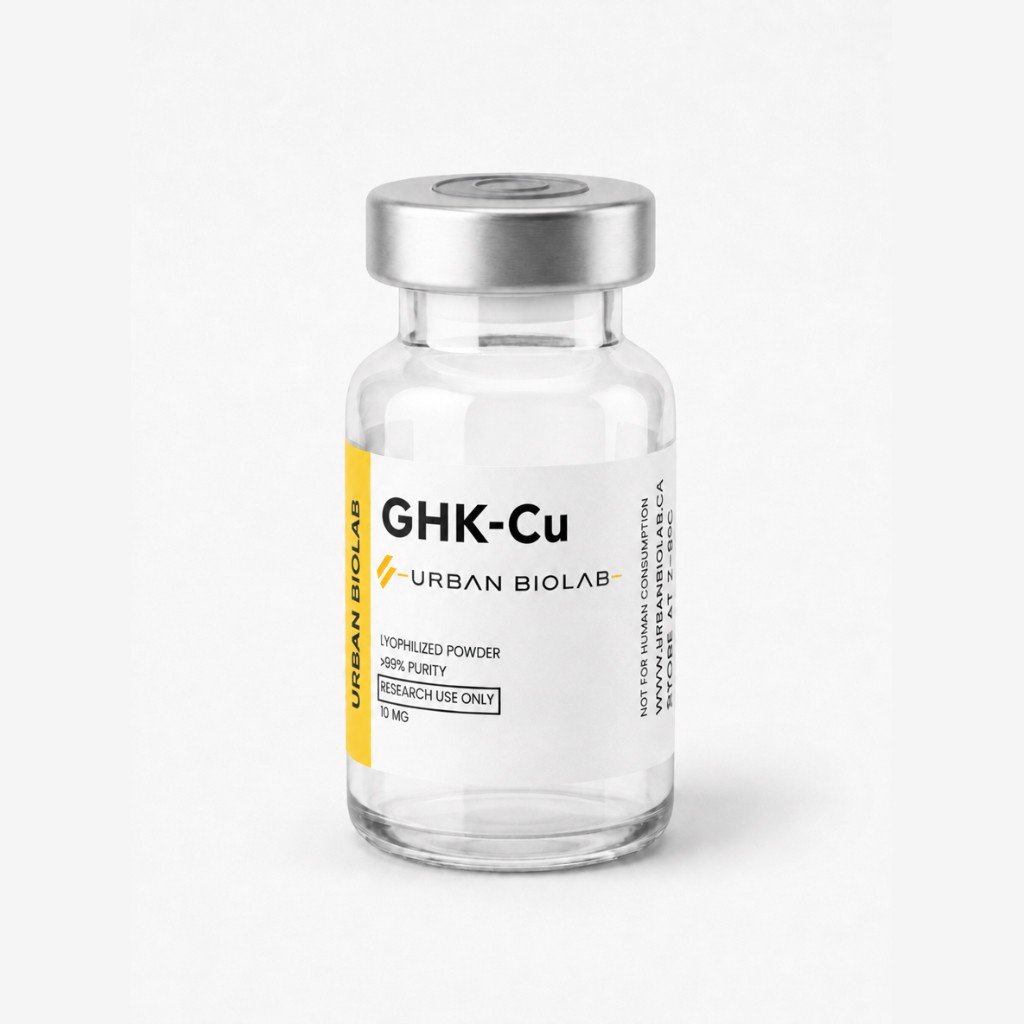
GHK-Cu 80MG
GHK-Cu 50mg is a copper-binding research peptide complex widely studied for its role in cellular signaling, tissue remodeling, and regenerative biology pathways. In laboratory research settings, GHK-Cu has attracted interest for investigations into wound-healing models, collagen synthesis pathways, and antioxidant activity, making it a valuable compound in skin, tissue, and cellular regeneration research.
GHK-Cu versus GHK
GHK and GHK-Cu are closely related, but they aren’t identical research materials.
GHK refers to the copper-free tripeptide.
GHK-Cu refers to the complex formed when GHK coordinates a copper ion.
The distinction matters because copper itself participates in numerous biological processes.
Researchers interested specifically in copper transport, copper-dependent enzymes or the behaviour of the coordinated complex need to consider the copper component rather than treating the two materials as interchangeable.
GHK-Cu versus AHK-Cu
AHK-Cu is another copper-binding peptide sometimes compared with GHK-Cu.
The two molecules differ in their amino-acid sequence:
| Peptide | Sequence |
|---|---|
| GHK | Gly-His-Lys |
| AHK | Ala-His-Lys |
Both can form copper complexes, but they should not be treated as interchangeable.
GHK-Cu has the considerably deeper published research history, extending back decades across extracellular-matrix biology, copper transport, oxidative stress and gene-expression research.
AHK-Cu has a smaller research literature and represents a separate molecule requiring its own experimental evaluation.
Understanding peptide purity
When evaluating a research peptide, purity is one of the most frequently advertised specifications.
It’s also one of the most frequently misunderstood.
A supplier might advertise:
≥98% purity by HPLC
That can be useful information, but it doesn’t answer every question about the material.
High-performance liquid chromatography — HPLC — separates components of a sample and can be used to characterize its purity profile.
A strong primary peak with relatively small impurity peaks may indicate a highly purified sample.
But HPLC purity alone doesn’t necessarily establish molecular identity.
A highly pure sample of the wrong compound would still be the wrong compound.
That’s why researchers should distinguish between purity and identity.
HPLC versus mass spectrometry
HPLC and mass spectrometry answer different analytical questions.
HPLC
Primarily helps researchers evaluate the composition and purity profile of a sample.
Mass spectrometry
Provides information about molecular mass and can help confirm molecular identity.
For research materials, these methods are complementary.
A useful analytical package therefore provides more information than a single purity percentage.
Researchers should ideally be able to determine:
What is in the sample?
Is it the expected molecule?
How pure is it?
Which batch was tested?
Why batch-specific Certificates of Analysis matter
A Certificate of Analysis — usually abbreviated COA — summarizes analytical information associated with a particular material or batch.
The important word is particular.
A generic COA displayed permanently on a website doesn’t necessarily tell a researcher anything about the vial or batch currently being supplied.
Useful research documentation should provide traceability.
Depending on the analytical work performed, researchers may look for information such as:
- product identity;
- lot or batch number;
- testing date;
- analytical method;
- HPLC results;
- mass-spectrometry results; and
- identification of the testing laboratory.
The batch identifier on the documentation should correspond with the research material being supplied.
That creates a chain between the physical material and its analytical results.
What does “third-party tested” mean?
This phrase appears frequently in the research-peptide market.
Ideally, it means that analytical testing was performed by a laboratory independent of the company selling the material.
But the words third-party tested aren’t themselves proof of anything.
Researchers should be able to inspect the underlying analytical documentation.
A useful question is therefore not:
“Does the website say third-party tested?”
It is:
“Can I see the batch-specific analytical results?”
Transparency matters more than the marketing phrase.
What should researchers look for in GHK-Cu documentation?
There isn’t one number that establishes the quality of every research peptide.
Instead, researchers should evaluate the complete analytical picture.
Useful documentation can include:
- batch-specific identification;
- HPLC chromatograms;
- reported purity;
- mass-spectrometry data;
- testing dates;
- laboratory identification;
- quantity and sequence information; and
- appropriate storage information.
The purpose is reproducibility.
If researchers cannot establish what material was used in an experiment, reproducing or interpreting that experiment becomes considerably more difficult.
Storage and stability
Peptides are sensitive research materials.
Temperature, moisture, light and repeated environmental exposure can affect stability over time.
Lyophilization — freeze-drying — is commonly used to improve stability during storage and transportation.
For researchers, appropriate storage should follow validated information provided for the specific material and experimental application rather than relying on generic instructions that assume every peptide behaves identically.
Transport conditions also matter.
A material can leave a laboratory meeting specification and still be compromised by inappropriate handling before reaching the researcher.
That makes documented storage and shipping practices part of the wider quality-control picture.
Why Canadian sourcing can matter for Canadian laboratories
For a Canadian laboratory, domestic sourcing can offer practical advantages.
Shorter transportation distances can mean less time in uncontrolled shipping environments.
Domestic orders may also eliminate international customs delays and foreign-currency transactions.
However, geography shouldn’t be confused with quality.
A Canadian supplier isn’t automatically a good supplier simply because it ships from Canada.
Analytical transparency remains more important.
Researchers should evaluate the same fundamentals regardless of where a supplier operates:
identity, purity, traceability, documentation and handling.
GHK-Cu’s status in Canada
GHK-Cu should not be confused with a Health Canada-authorized pharmaceutical product.
Research materials and approved therapeutic products operate in very different contexts, and the existence of scientific literature surrounding a compound does not itself establish regulatory authorization for a medical use.
Canadian researchers and organizations working with research compounds should ensure that their activities, claims, labeling and intended applications comply with applicable Canadian requirements.
This is particularly important because regulatory classification can depend on factors including how a product is represented, its intended purpose and the claims made about it.
A “research use only” label should therefore not be treated as a substitute for understanding the applicable regulatory framework.
What researchers still don’t know about GHK-Cu
GHK-Cu has been studied for decades, but a large literature doesn’t mean every question has been answered.
Some of the most interesting areas for future research include:
Gene-expression effects
How reproducible are the broad gene-expression patterns reported in earlier experimental work?
Mechanism
Which effects result directly from GHK signalling, which depend on copper, and which emerge specifically from the GHK-Cu complex?
Cellular specificity
Do different cell types respond differently to GHK-Cu?
Aging biology
What is the biological significance of declining endogenous GHK concentrations with age?
Comparative copper-peptide research
How does GHK-Cu differ mechanistically from other copper-binding peptides such as AHK-Cu?
These are much more interesting scientific questions than simply asking whether GHK-Cu “works.”
The bigger picture
GHK-Cu is a useful example of why peptide biology can be surprisingly complex.
Three amino acids don’t sound like much.
But when those amino acids form a structure capable of binding an essential metal ion and interacting with multiple biological systems, the resulting research questions become much broader.
GHK-Cu sits at the intersection of several fields:
peptide signalling
copper biology
extracellular-matrix regulation
oxidative stress
gene expression
regenerative biology
That intersection helps explain why researchers are still investigating the molecule more than 50 years after GHK was first identified.
The bottom line
GHK-Cu is one of the more extensively studied copper-binding peptides in biological research.
Evidence from laboratory and experimental research has connected GHK and GHK-Cu with extracellular-matrix activity, oxidative and inflammatory signalling, cellular repair processes and changes in gene expression.
But the strength of the evidence varies considerably between research areas, and experimental findings shouldn’t automatically be translated into claims about effects in humans.
For researchers evaluating GHK-Cu, the analytical side is equally important.
A compelling biological hypothesis means little if the material being studied cannot be reliably identified.
That’s why good GHK-Cu research begins with three basic questions:
Is it the expected molecule?
How pure is the material?
Can the analytical results be traced to the specific batch?
Those questions aren’t particularly glamorous.
But good science rarely begins with the marketing claim.
It begins with knowing exactly what you’re studying.
Frequently Asked Questions
What is GHK-Cu?
GHK-Cu is a complex formed between the naturally occurring tripeptide glycyl-L-histidyl-L-lysine (GHK) and a divalent copper ion (Cu²⁺).
What does GHK-Cu stand for?
GHK represents the amino acids glycine, histidine and lysine. Cu is the chemical symbol for copper.
Why is GHK-Cu studied?
Researchers have investigated GHK-Cu across areas including extracellular-matrix biology, collagen-related processes, oxidative stress, inflammatory signalling, cellular repair and gene expression.
Is GHK-Cu the same as GHK?
No. GHK is the copper-free tripeptide. GHK-Cu is the complex formed when GHK binds copper.
Is GHK-Cu the same as AHK-Cu?
No. GHK and AHK have different amino-acid sequences. Although both can form copper complexes, they are distinct research compounds.
What does HPLC tell researchers about GHK-Cu?
High-performance liquid chromatography can be used to characterize the composition and purity profile of a sample. HPLC purity should not be confused with confirmation of molecular identity.
Why is mass spectrometry important?
Mass spectrometry provides information about molecular mass and can help establish whether the material being tested corresponds to the expected compound.
What is a GHK-Cu Certificate of Analysis?
A Certificate of Analysis summarizes analytical information associated with a product or batch. Researchers should look for traceable, batch-specific documentation rather than relying solely on generic purity claims.
Is GHK-Cu approved as a pharmaceutical treatment in Canada?
GHK-Cu should not be represented as a Health Canada-authorized pharmaceutical treatment merely because it is available as a research material. Regulatory status and requirements depend on the product’s intended purpose, representation and applicable Canadian rules.
Does “research use only” determine a product’s legal status?
Not by itself. Labeling is one factor, but regulatory classification can also depend on intended use, product representation, claims and other circumstances. Organizations working with research compounds should assess the Canadian requirements applicable to their specific activities.
References
- Pickart L, et al. Regenerative and protective actions of the GHK-Cu peptide in the light of the new gene data. International Journal of Molecular Sciences. 2018.
- Pickart L, Margolina A. Regenerative and protective actions of the GHK-Cu peptide in the light of the new gene data and possible counteraction of neurodegenerative and cognitive decline. Research literature concerning GHK/GHK-Cu.
- Pickart L, Vasquez-Soltero JM, Margolina A. The human tripeptide GHK-Cu in prevention of oxidative stress and degenerative conditions of aging: implications for cognitive health. Oxidative Medicine and Cellular Longevity. 2012.
- Pickart L, Margolina A. Research concerning GHK-Cu, stem-cell activity and gene expression.
- Skibska A, Perlikowska R. Signal peptides — promising ingredients in cosmetics. Current Protein and Peptide Science. 2021.
- Maquart FX, et al. Glycyl-L-histidyl-L-lysine stimulates collagen synthesis in fibroblast cultures. FEBS Letters. 1988.
- Health Canada. Drug and health-product regulatory information.
Research Use Notice: This article is provided for scientific, educational and laboratory-reference purposes. It does not provide instructions for personal use and should not be interpreted as medical advice.